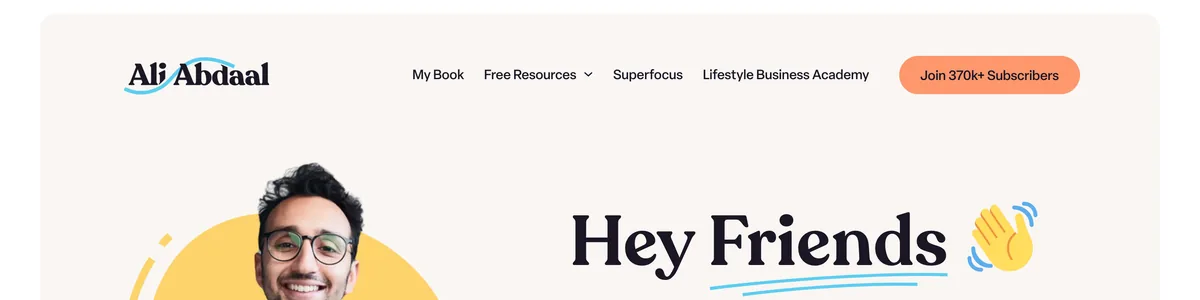
Ali Abdaal went from a Cambridge medical school lecture hall to a creator business that, by his own published figures, reported over $3.5 million in revenue in 2021 and later crossed $6 million a year. The doctor-turned-YouTuber then deliberately stopped trying to scale further, setting a stated goal of $2 million a year in profit instead. The Ali Abdaal founder story isn’t a recap of his productivity advice. It’s a business case study in the mechanics: how a medical qualification served as the wedge, how each content format funded the next, and what the team behind the “one-person business” actually looks like. The goal is to show solopreneurs which parts transfer to a smaller operation.
Building a Channel While Studying and Practicing Medicine at Cambridge

Ali Abdaal was born May 11, 1994, and took the conventional route into medicine, studying at Cambridge University and earning an MB BChir. The medical degree gave him credibility and structure, but it also made the timeline tight: the six years of training consumed most of his time, leaving little room for a side project.
He launched his YouTube channel anyway, while still in medical school. Sources date the start to either 2014 or 2017, and the discrepancy matters less than what both accounts agree on: the channel began as a side project during training, not as a deliberate career pivot. Early uploads were practical exam-technique videos aimed at other medical students, a narrow niche that made sense given his circumstances. He was producing content for the audience he actually belonged to.
After completing his medical education at the end of 2018, Abdaal practiced as a junior doctor in the UK National Health Service for two years, including full-time work during the pandemic. Those were demanding clinical hours layered on top of a growing content operation. The key discipline through that period was consistency: he treated the channel as a side business, publishing on a regular cadence while studying and practising rather than waiting for a stretch of free time that never arrived. The output was modest in scale but steady, and that steady output is what let the compounding begin.
Exam-Technique Videos for a Tiny Audience – and the Compounding That Followed

Abdaal’s first audience wasn’t the productivity crowd that eventually made him famous. It was medical students, or more precisely, students trying to get into medical school. His early videos were exam-technique walkthroughs and study-tip explainers, the kind of content that only made sense to someone staring down a competitive admissions process. That is a small niche, and it stayed small for a long time.
He produced more than 300 videos before earning substantial income from the channel. That number matters because it reframes how the growth actually happened: not through a single breakout upload or a lucky algorithm push, but through repeated shipping over years. Each video reached a tiny audience, and each one compounded into the next. The 300-video mark is the point where the math starts to work in the creator’s favor, not because any one upload performed, but because the catalog had become deep enough that new viewers had years of content to work through.
The expansion came gradually. As the medical school content accumulated, Abdaal broadened into productivity, personal development, and study techniques that applied beyond the admissions process. The niche widened without being abandoned. The credibility built in the early exam-technique days carried over, so when he started talking about note-taking systems and focus techniques, he was doing it as someone who had already demonstrated mastery in a harder, narrower field. That positioning is what let the audience grow from aspiring doctors to a general productivity audience without a credibility reset.
The compounding effect here was discipline, not virality. He kept making exam-technique videos for a tiny audience long after the returns were visible, trusting that steady output would eventually pay off. It did. By the time his YouTube income had grown enough to surpass his medical salary, the channel had become a different business entirely, one built on a foundation of hundreds of unglamorous uploads rather than a handful of hits.
Leaving Medicine: How He Describes Making the Call
The decision to leave medicine came in 2020, and the timing was not coincidental. That was the year Ali Abdaal crossed 1 million YouTube subscribers, the same threshold where the channel’s income had grown enough to replace his junior doctor salary. The medical career he had trained eight years for was no longer the more lucrative option, and the math had quietly flipped in favor of the side project.
His own framing of the decision is worth reading closely, because it is less about money and more about identity. “Leaving medicine meant decoupling my identity from a profession I trained eight years for,” he has said. That sentence gets at something specific: the difficulty was not walking away from a paycheck but walking away from a self-definition that had taken nearly a decade to build.
He has also described it as a move toward something rather than away from something, saying, “I left medicine for the flexibility and creative autonomy that comes with being a full-time entrepreneur.” The creator work, in his telling, felt “more intense, exciting, and fulfilling” personally.
The reasoning he shares is notable for how unapologetic it is. Abdaal has said outright that “you don’t need a catastrophic reason to leave a good career; simply wanting to try something else is reason enough.” That is a deliberately unromantic position, and it sits in tension with how most career-transition stories are told. There is no burnout narrative here, no dramatic breaking point. He applied a regret-minimization framework instead, weighing the downside of staying against the downside of leaving, and landed on a simple hedge: he could always return to medicine if the business failed. The qualification was not being discarded, just shelved.
That last point is the one that makes the transition less risky than it looks from the outside. A medical degree does not expire the way a tech skill might, and the option to return kept the downside bounded. The decision was still a leap, but it was a leap with a safety net, which is a very different calculation from the one most people imagine when they picture quitting a stable career to go full-time on content.
The Disclosed Revenue Mix: Ads, Sponsorships, Courses, and the Book
The question of how Ali Abdaal makes money has a clearer answer than most creator-economy case studies, because he has published his own income breakdowns over the years rather than leaving outsiders to guess. Those figures, not third-party estimates, show a business that reportedly generated over $3.5 million in 2021 and later crossed $6 million a year before he deliberately chose not to scale further. The revenue streams behind those numbers break down like this:
The first Part-Time YouTuber Academy launch enrolled 350 students and brought in $250,000, with course pricing between $1,495 and $4,995.
His Skillshare classes generated $475,700, viewed for over 9 million minutes by 100,000 students.
While ads and sponsorships contribute, the main income driver is high-ticket online education. His book Feel-Good Productivity (2024) became a New York Times bestseller, but he has not published a specific book revenue figure.
YouTube ad revenue and sponsorships get the attention, but they function more as top-of-funnel marketing than as the core business. The real engine is the course business, where a single launch can out-earn a year of ad revenue. The book, meanwhile, is a credibility play as much as a revenue line, adding the authority that makes a $4,995 course price point feel justified.
The Team Behind a One-Person Business That Has Staff
Abdaal has never actually worked alone, despite the “one-person business” label. The outsourcing began in 2019, when he started sending video editing work to freelancers on platforms like Upwork, and the team has only grown since. The structure that supports his output looks like this:
Becky Isjwara joined as Head of YouTube in March 2025, leading production and managing sponsor integrations. She writes the sponsor scripts that Abdaal reads line by line, and coordinates publishing cadence across the editors.
Saf Mohammed helped grow the channel from 3 million to 6 million subscribers in two years, landing the role at age 24 with no prior portfolio. He has since left to run Talking Heads, a YouTube agency.
The broader operation spans Sparkle Studios as the holding structure, CreatorGrid (co-founded with Izzy Sealey), a platform that connects creators with brand deals, and the Not Overthinking podcast co-hosted with his brother Taimur Abdaal. CreatorGrid counts Notion, Superhuman, Wispr, Todoist, Morning Brew, and Epidemic Sound among its partnerships.
So “one-person business” means one owner, not no staff. The label describes who holds the equity and the creative direction, not how many people it takes to ship a weekly video, run a course launch, and manage a podcast. Abdaal keeps the strategic calls and revenue decisions for himself, while the day-to-day production, editing, and sponsor coordination sit with people who specialize in those roles. That division is the practical answer to how a channel with millions of subscribers and a high-ticket course business runs without the founder drowning in operational work.
The Criticism: Productivity Content About Making Productivity Content
The most common criticism leveled at Abdaal is that his content is meta in a way that borders on self-referential. He makes videos about productivity systems, and the primary productivity system in question is the one that produces the videos themselves. The audience watches a video about building a note-taking workflow, then realizes the workflow exists to help him make more videos about note-taking. It is a loop, and the criticism is that the loop is the product.
There is real circularity in a business where the subject matter and the medium are the same thing. A course about running a YouTube channel is, in a literal sense, a YouTube channel about running a channel.
But the deeper claim behind the criticism, that Abdaal is a self-help author who happened to find video as a delivery mechanism, does not match the actual product path. His model is YouTube-first, not book-first. The channel came before the book, before the course, before any of the products that carry the higher price tags. Feel-Good Productivity (2024) is a bestseller, but it arrived years after the channel had already built its audience and its revenue base. The book is an extension of the YouTube business, not its origin. The direction of that dependency matters, because it means the criticism describes a symptom of the model rather than the model itself.
Where Abdaal differentiates is in the emotional framing of productivity itself. The dominant school in the space, from the discipline-and-grind productivity influencers to the systems-and-optimization crowd, tends to sell effort as the answer: wake earlier, track more, push harder. Abdaal’s positioning runs the opposite way. He argues that a feel-good approach, one that connects productivity to enjoyment rather than willpower, is more sustainable over the long run, especially for creators who need to produce on a weekly cadence for years. It is a softer sell than the discipline school, and it is also a more defensible one for someone whose business depends on not burning out.
His stated business philosophy is a direct counter to the accusation that the content is hollow. “Your YouTube channel should be treated like a business asset rather than just a hobby,” he has said, and “Your videos are products that viewers pay for with their time and attention.” Those two sentences reframe the loop from self-indulgence to exchange. If a video is a product and a viewer’s attention is the payment, then the meta-ness is not a flaw. It is the business model operating as intended. The audience is paying with time and attention for content about how to earn more of both.
The more telling quote is the one about the tools. “The tools and cameras matter far less than the act of creating and shipping content,” Abdaal has said. That is the claim that separates his approach from the gear-and-guru posturing that fills the productivity corner of YouTube. The core mechanic, in his telling, is not a better camera or a more elaborate system. It is the repeated act of shipping. The hundreds of early exam-technique videos, made for a tiny audience with modest equipment, are the proof of that claim. The criticism says the content is just content about making content. His answer is that making content, consistently, is exactly the skill his audience is paying to learn, and the fact that the medium demonstrates the lesson is the point, not the problem.
What Transfers to a Smaller Creator: A Qualification as a Wedge, Each Format Funding the Next
The most important fact about Ali Abdaal’s early success is that his medical qualification was never the content topic. It was a trust wedge: an existing credential that gave early viewers a reason to listen to his study and exam advice before he had any track record as a creator. That distinction matters for solopreneurs, because it means the credibility was earned before the content was made, not through it. The transferable mechanics of his business model break down into a few lessons worth stealing:
Each format funded the next. YouTube built the audience, the Part-Time YouTuber Academy converted that audience into high-ticket course revenue, and the book extended the brand after the course had already proven demand. No single stream had to carry the whole business at once.
He advises creators to limit themselves to 3 to 5 active projects per week to avoid overloading capacity, and to implement systems rather than relying on inspiration. The discipline is structural, not motivational.
The model’s transferable core is validated offers and lead generation, not “build an audience first.” He explicitly says the traditional advice is outdated, pointing instead to offers that have been tested against real demand and a pipeline that brings people to them.
The qualification was the wedge, and each format funded the next.
A solopreneur does not need a medical degree to replicate the shape of that sequence, but does need some equivalent of the wedge, some credential, skill, or demonstrated result that gives strangers a reason to listen before the content has earned their attention. Everything else is just the order in which the pieces were assembled.
The Business Mechanic Behind the Ali Abdaal Founder Story
As a whole, Abdaal’s operation is a study in deliberate sequencing. The medical qualification was a wedge, not a ceiling: it earned early trust from a narrow audience, then got set aside once the business replaced the income it had paid for. The team behind the “one-person” label is real and layered, with editors, a head of YouTube, and a podcast co-host handling production while the owner keeps the strategic and revenue decisions. The scaling ceiling was self-imposed: he stopped growing past $6 million a year because the stated goal was $2 million in annual profit, not maximum revenue. That choice embodies his line, “Freedom comes from leaving money on the table,” and it is the clearest statement of what this business is actually for.
By Solopreneurs examines this and other founder models to show solopreneurs which mechanics transfer to a smaller operation. The takeaway here is not the scale or the subscriber count. It is the order of operations. Validate with one format before funding the next. YouTube proved the audience, the course proved the willingness to pay high ticket prices, and the book extended the brand only after both had been established. Each step funded and de-risked the one after it. That sequence is replicable at any size, with or without a credential as the opening wedge, because the underlying discipline is the same: prove demand in one channel, then use the returns to build the next.


Leave a Reply