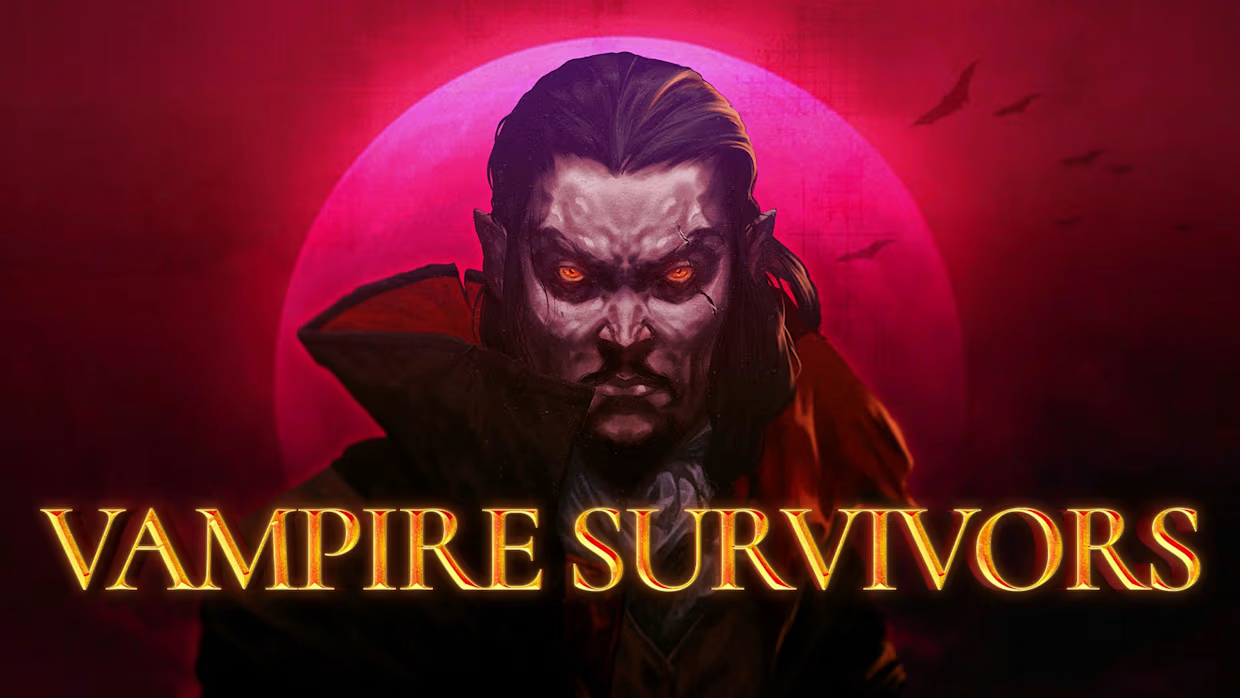
The Luca Galante founder story starts with a day job in mobile gambling. Vampire Survivors was built largely by one person, a former gambling-game developer who worked on it in his spare time. It sold for $2.99 and, by April 2022, had moved 2.5 million copies according to data cited by Orbis Patches, after launching quietly in December 2021.
Vampire Survivors is widely considered one of the first “bullet heaven” games, a genre label that didn’t exist before it and a template that numerous later titles copied outright. Its success culminated in a BAFTA Best Game win in 2023, beating heavyweights like Elden Ring and God of War Ragnarök.
It turned a spare-time project into one of the most influential indie games of its era.
Luca Galante’s Path from Gambling Games to Indie Side Projects
Vampire Survivors started well before its December 2021 launch, and it came out of an unlikely industry. Luca Galante spent years working in gambling, building slot-machine-style games where flashy graphics and reward loops were the core product. That experience left a visible mark on Vampire Survivors. The chest-opening animations that pop with color and anticipation borrow directly from the visual language of slot machines, a deliberate carryover from his professional background rather than an accident of style.
His day job at the time was on a mobile gambling title, and Vampire Survivors began as a creative outlet from that work. It was a side project in the truest sense, built in spare hours to offset the demands of a job that focused on monetization loops rather than player fun. Galante has described the game’s origins in those terms, as a project to give himself a break from his daily work rather than a calculated career move.
Before Vampire Survivors, he had already tested his limits with a different kind of project. Galante committed to a grueling schedule of long nights on a Unity-based RPG, pouring hours into a larger, more ambitious game that demanded far more of him. The RPG was too heavy, too slow to build, and too risky for a spare-time effort. When he scaled back, he chose Java as his tool and built Vampire Survivors as a lower-stakes, more fun project that could be iterated on without the demands of a sprawling codebase.
Galante emigrated to England to pursue a career in the industry, carrying a childhood shaped by the Commodore 64 and the original PlayStation. Those early machines left a clear imprint on his sensibilities, and the arcade-like immediacy of Vampire Survivors owes something to the games he grew up on. The gambling industry gave him a professional education in what makes players keep going. The consoles of his youth gave him the reference points for what makes a game worth coming back to. Vampire Survivors sits where those two influences meet.
The History of Vampire Survivors and Its Borrowed Mechanics
The history of Vampire Survivors starts with a clear set of influences that Galante openly drew from. The most direct was Magic Survival, a 2019 mobile game built around a character that automatically attacks enemies without player input. The core loop of Vampire Survivors, where the player moves while combat happens on its own, comes straight from that template. Galante borrowed the structure rather than inventing it, then refined it into something tighter and more addictive than the original.
Galante also pointed to the Castlevania series as a source of inspiration. One art asset pack he purchased included sprites in a similar style to early Castlevania characters, which gave the game its unmistakable gothic look without requiring him to commission original artwork from scratch. The visual identity of Vampire Survivors, down to its monster designs and shadowy palette, traces back to that single asset pack as much as to the games themselves.
The technical foundation was deliberately modest. Galante built the initial early access version in about a year using the Phaser framework, a lightweight JavaScript game engine suited to 2D browser games. His total spend on assets, art, and music came to roughly £1,100, a figure that shows how little a focused solo project needs when the scope is kept small. The game later migrated from Phaser to Unity starting with version 1.6, a move that came as the project grew beyond what a browser-based framework could handle.
Community management was part of the plan from the start, shaped by an earlier chapter in Galante’s life. He had worked as an administrator for an Ultima Online server, a role that taught him how to run a player community and keep people engaged over time. He carried that experience into Vampire Survivors, treating the game’s audience as a community to nurture rather than a passive group of buyers. That mindset would prove important later, when the game’s player base expanded far beyond anything the early access launch could have predicted.
The Early Access Timeline and the $2.99 Price Decision
Galante first put the initial version on itch.io, where it drew little engagement and sat largely ignored. Rather than treat that as a verdict on the game, he decided to release on Steam before the end of 2021. The move made sense for a project built on minimal art aesthetics, since a game that looked this simple could afford to sell at a price that matched its appearance.
That price was $2.99, and it was a deliberate choice rather than a default. Galante set the cost low specifically so the game could reach a larger audience, expecting that a cheap entry point would pull in players who might hesitate at a higher price for a solo project in early access. The strategy was sound on its face, though the early returns gave little reason for confidence. Steam Charts records a December 2021 average of 4.13 concurrent players and a peak of 12, numbers that would have ended most games before they gained traction.
On the same day the game hit Steam, Galante contracted COVID-19 and spent the immediate aftermath focused on recovery rather than sales. A game with a dozen peak players and a developer sidelined by illness is not a promising picture, and there was nothing in those first weeks to suggest the explosion that would follow. The $2.99 price was the one decision in that stretch that would pay off at scale, because it meant the game was positioned to convert curiosity into purchases the moment anyone actually showed up to look. The price held at $2.99 for all but the final month of early access. It rose to $4.99 in September 2022, a month before the 1.0 release.
How Streamers and Word of Mouth Turned the Game into a Hit
In early 2022, Galante learned that some YouTube creators had picked up the game on their own, and their videos were driving a measurable increase in Steam sales. There was no coordinated marketing push behind this, no press release, no influencer budget. It was a cheap, fun game that was also entertaining to watch, and the people watching it decided they wanted to play it too.
The game’s on-screen chaos, the screen-filling swarms of enemies, the escalating power curve, all of it reads well on camera. A viewer can understand the appeal in seconds without ever touching the controls, and at $2.99, the gap between watching and buying was almost nonexistent. The low entry price turned word-of-mouth viewers into buyers immediately, which put more copies in more hands and generated more streams and videos.
The numbers climbed at a startling pace once momentum built. By late January 2022, the game had reached over 30,000 concurrent players on Steam, and the following month it surpassed 70,000. Steam Charts records a January 2022 peak of 50,847 concurrent players and a February 2022 peak of 77,061, an all-time high for the game. For a title that had averaged just over four concurrent players in its launch month, the climb was extreme by any measure.
GameSensor forecast almost $7 million in sales and nearly 2 million copies sold in the first month of the game’s full release on Steam. Those figures were projections rather than confirmed numbers, but they captured the scale of what the streaming-driven wave had produced. A spare-time project built for roughly £1,100 in assets was now generating revenue at a level that would have been unthinkable during the game’s quiet December launch.
Scaling Up: Leaving the Day Job and Founding Poncle
The surge in players did not immediately change how Galante worked. Even as concurrent numbers climbed past 70,000 and sales projections reached into the millions, he kept his day job well into 2022. Quitting in February of that year was a measured decision rather than a sudden move, made once it became clear that the game’s momentum was real and that Vampire Survivors demanded his full attention. The choice to leave came from practical necessity as much as ambition. A game growing this fast needed constant care, and a part-time schedule could no longer provide it.
Around the same time, Galante founded poncle as his studio name, turning a solo project into the foundation of an actual company. In March 2022, he hired multiple freelancers to expand the team and accelerate development, a move that signaled a shift from maintaining a finished-feeling early access game to building a pipeline of ongoing work. That scaling was deliberate and incremental, matching the pace of the game’s growth rather than racing ahead of it.
Sam McGarry, a former coworker who now works at poncle, described how colleagues could not stop playing a prototype Vampire Survivors during a hobby project showcase at their former employer. The same pull that later drove millions of players had been visible in a small office long before the Steam charts showed it.
Galante kept his focus on the work rather than the attention. He said of the success: “Since launch I’ve been trying to not look at numbers or at what’s happening online specifically to not get too carried away, kept my head down and kept working on the game and on the company, focusing almost entirely on the feedback from the players.” That discipline, of prioritizing player feedback over public attention, shaped how poncle operated from the start and set the tone for the studio’s steady expansion.
The Developer’s Path to Full Release, DLC, and New Platforms
Galante expanded the game across platforms and into paid DLC at a pace that matched the momentum his early access run had built. The release history that follows lists dated milestones, each extending the game’s reach to a new audience or adding fresh content for existing players.
Date | Milestone |
|---|---|
October 20, 2022 | Full game released for macOS and Windows |
November 10, 2022 | Xbox One and Xbox Series X/S port released |
December 8, 2022 | Android and iOS ports released. They were fast-tracked in response to clones on mobile app stores that used stolen code and assets. Mobile versions are free-to-play with optional ads, unlike the inexpensive premium releases on other platforms |
December 15, 2022 | First paid DLC, Legacy of the Moonspell, released |
August 17, 2023 | Nintendo Switch version released, adding local co-op for up to four people |
September 2023 | Tesla cars version released with the 2023.26 firmware update |
October 31, 2024 | Ode to Castlevania released, the largest DLC with 80 characters. Galante called it a “full circle moment” |
November 13, 2025 | Meta Quest VR port released |
June 2026 | Game’s name expanded to “Vampire Survivors – First Survivaton” as part of a free update |
April 21, 2026 | Spin-off roguelike deck-builder Vampire Crawlers released |
The mobile releases deserve particular attention because they mark the one place where the pricing strategy shifted. Where the desktop and console versions sold as inexpensive premium titles, the Android and iOS ports went free-to-play with optional ads, a model that reflects the realities of mobile app stores as much as it does player preference. The clones that prompted the fast-tracked release had proven there was demand on mobile, and the free-to-play structure was the most direct way to capture it.
Sales on other platforms also benefited from inclusion in bundles and subscription services like Xbox Game Pass, which put the game in front of players who might not have sought it out on their own. Each platform expansion and DLC release added another entry point to a game that had already demonstrated an unusual ability to convert curiosity into long-term engagement.
Awards and Recognition for Vampire Survivors
The Vampire Survivors success story reached its most public milestone at the 2023 BAFTA Games Awards, where the game took home Best Game, beating Elden Ring and God of War Ragnarök in the process. It also won Game Design that night, and its five total nominations included British Game, Debut Game, and Original Property. For a solo project that had launched quietly just over a year earlier with a dozen peak players, the recognition was a striking measure of how far the game had traveled.
The awards trail began before the BAFTAs. At the 2022 Golden Joystick Awards, the game won the Breakthrough Award and earned a nomination for Best Early Access Launch. The DICE Awards added another win for Action Game of the Year, alongside nominations for Game of the Year, Outstanding Achievement for an Independent Game, and Outstanding Achievement in Game Design. The Game Awards also put the title forward for Best Debut Indie Game, and the New York Game Awards recognized it with the Off Broadway Award for Best Indie Game.
At the 2025 BAFTA Games Awards, Vampire Survivors won Best Evolving Game, an award that fits a title whose post-launch history has been defined by relentless updates, new platforms, and a steady stream of DLC.
Critical reception tells a similar story. Metacritic lists the Windows version as “generally favorable,” while the Xbox Series X/S and iOS versions sit in “universal acclaim” territory. Those scores reflect a game that reviewers found easy to underestimate and hard to put down, a pattern that repeated across platforms as the title expanded beyond its original PC audience.
Lessons for Solo Founders from the Luca Galante Story
Galante’s choices were deliberate calls made under uncertainty, and each one maps to a principle that translates beyond game development.
Price shapes growth as much as revenue. The $2.99 price tag lowered the barrier for a game with minimal art to a point where curiosity cost almost nothing. Galante chose it specifically because the low price could reach a larger audience, and that audience became the fuel for the streaming wave that followed. A lower price meant more purchases, more players, more streams, and more purchases again.
Ship the game before it feels finished. The early access version reached Steam in December 2021 with little engagement, and by most reasonable measures it looked like a failure. Releasing it allowed streamers and players to find the game on their own terms. A finished-feeling product would have taken months longer to reach the market, and the market was ready before the game was polished.
Momentum comes from steady updates. After the breakout, Galante hired freelancers in March 2022, kept releasing free content, and added paid DLC only after building a large player base. The steady cadence of updates kept the game in conversations, in feeds, and in front of new players long after the initial spike. Momentum is a maintenance habit, not a one-time launch event.
For more founder stories like this, follow By Solopreneurs.
Leave a Reply