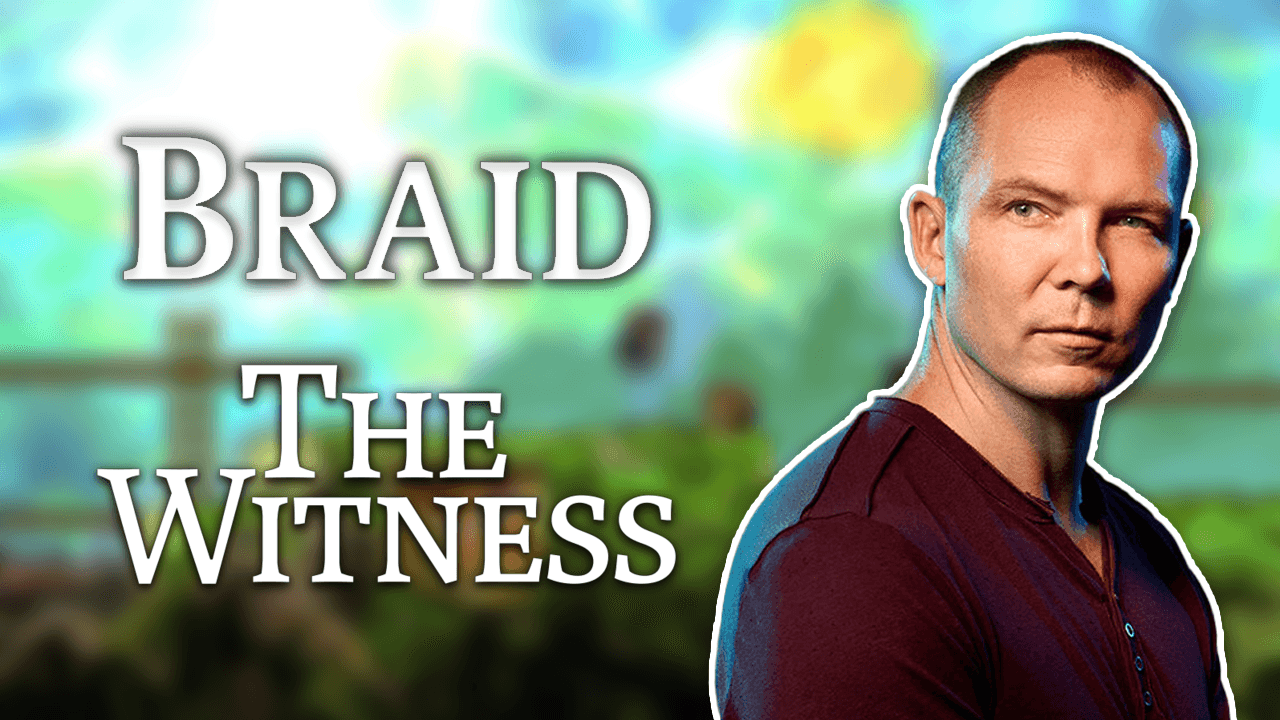
Before Braid, before The Witness, before the programming language he’s now building, Jonathan Blow was a working programmer who kept betting his own money on the projects he believed in. The Jonathan Blow founder story is a record of those bets and what each one cost him.
Born in 1971 in California, Blow attended UC Berkeley before dropping out. At 24, he took $24,000 in savings and co-founded a game design company with a Berkeley friend. According to The Atlantic’s profile of his early career, the business folded after four years, leaving him roughly $100,000 in debt. That company, Bolt-Action Software, dissolved around 2000 to 2001 amid the dot-com crash, and Blow shifted to freelance contracting to dig himself out.
Blow didn’t stumble into success. He built a failed company, carried years of debt, and worked freelance contracts, all before producing the game that would change his trajectory. The bets got bigger, not smaller, and each one was funded with his own money. That willingness to reinvest everything into the next project is the thread that runs from a $24,000 startup through a seven-year, roughly $6 million follow-up, and now into a programming language that represents the same gamble all over again.
Self-Funding Braid Took More Than $180,000 and Years of Debt
Braid began as a vacation idea. Blow conceived the game in late 2004 while traveling in Thailand, and by the end of 2005 the puzzles were finished. What followed wasn’t a quick release but a long, deliberate polish period, because Blow refused to ship until the game was genuinely ready. That decision stretched development past the three-year mark, with the game finally arriving in August 2008.
Blow, the Braid developer, funded the entire project himself. According to his Wikipedia entry and The Atlantic, development costs reached $200,000, all covered out of his own pocket. Polygon later reported Blow’s own estimate of the cost as more than $180,000 of his own money. It was one person’s savings, funneled into a self-funded indie game with no guarantee of return.
The financial pressure was real and immediate. In late 2008, before any Braid revenue had arrived, Blow was $40,000 in debt and living in a modest San Francisco apartment, The Atlantic reported. The game was finished, polished, and set to launch, but the money had not yet come back to him.
The way Jonathan Blow funded Braid was straightforward: he spent his own money, went into debt to carry the project across the finish line, and trusted that a well-made game would eventually pay for itself. It was the second time in his career he had bet everything on a project he believed in, and the pattern would repeat again before long.
The Xbox Live Arcade Release That Proved a Solo Game Could Sell

When Braid hit Xbox Live Arcade in August 2008, the reception was immediate and unanimous. Critics praised its time-manipulation mechanics and its literary framing, and the game went on to sell several hundred thousand copies in its first year while collecting numerous industry awards, The Atlantic reported.
The XBLA release mattered because it broke an assumption that had quietly governed the business for years: that small, personal games were niche products, incapable of competing on a major console storefront. Braid arrived on a platform dominated by big-budget releases and sold in numbers that matched or beat many of them. It demonstrated that a single developer’s vision, priced and presented well, could find a mass audience. That lesson rippled outward through the rest of the Xbox Live Arcade era, encouraging other independent developers to bring their own ambitious projects to consoles.
Its appearance in Indie Game: The Movie also secured Braid’s place in indie game history. The 2012 documentary captured the XBLA moment when independent developers were first getting real visibility on a mainstream platform, and Braid was one of the games featured. The film gave the game a lasting spot in the story of independent development, framing it as one of the titles that opened the door for the wave of indie releases that followed. Stardew Valley is one of those, built by a single developer.
For Blow himself, the commercial success became real in a remarkably ordinary moment. He first checked his earnings at a café in San Francisco’s Mission district, later recalling his reaction as “Holy fuck, I’m rich now,” The Atlantic reported. After years of debt, freelance work, and a $200,000 personal investment, the game had finally paid him back and then some.
What Braid Earned and Why He Reinvested Nearly All of It
By April 2014, Braid’s sales had earned more than $4 million, according to The Atlantic and Wikipedia’s entry on Jonathan Blow. After nearly a decade of debt, freelance work, and personal investment, the game had generated real wealth, and Blow had a choice about what to do with it.
There was one notable splurge. The Atlantic noted that Blow bought a $150,000 crimson Tesla Roadster after Braid’s success, a rare personal indulgence in a career otherwise defined by reinvestment. Everything else went back into the next project.
The idea of reinvesting indie game profits is common among developers, but Blow’s version of it was unusually total. He used almost all of Braid’s earnings, roughly $4 million as of April 2014, to fund The Witness, according to Wikipedia’s entry on the game. That meant he had no publisher, outside deadlines, or claims on creative direction. The trade-off was that the entire bet sat on his shoulders alone.
Before committing his own money, Blow had explored publisher partnerships and found each one wanting. Per The Paris Review, one publisher demanded lifetime rights to the game, another wanted unacceptable creative control, and a third insisted on a Q1 2011 release that would have forced the project out before it was ready.
Blow had spent years building toward creative freedom, and when the money finally arrived, he chose to spend it on more of that freedom rather than security.
The Witness: Seven Years and a Multi-Million-Dollar Personal Bet
The Witness development began almost immediately after Braid shipped. Blow started work in 2008, announced the project in 2009, and revealed it publicly in 2010, but the timeline that followed bore little resemblance to the one he had planned. The Witness was originally budgeted at about $800,000 and envisioned as an 18-month build producing a 5-hour game. It shipped seven years later with 677 puzzles and a final budget that had grown roughly eightfold from the original estimate.
The game’s scope at least tripled from the initial plans, per Wikipedia’s entry on the game. What started as a compact puzzle experience expanded into an open-world island dense with line-drawing puzzles, environmental clues, and hidden layers of meaning. The core team grew to eight people by 2015, and at the time it was very rare for a small indie studio to spend more than seven years on a single game. The Witness’s development cost ballooned accordingly, with Blow estimating during a launch-day Twitch Q&A that the project had cost close to $6 million. The Verge reported a figure of around $5 million, funded by Braid profits plus a loan from a friend.
By February 2015, the Braid money had run out. Blow told GamesIndustry.biz that Braid still sold well on platforms that were thriving, but two of its biggest platforms, the Xbox 360 and the PlayStation 3, were sunsetting. That meant the revenue stream that had carried The Witness for years was drying up before the game was finished, and Blow borrowed money to complete it. The pattern from Braid repeated itself: personal funds, then debt, then a final push to the finish line.
The Witness shipped in January 2016 on Windows and PlayStation 4 at $40, a deliberate contrast to Braid’s $15 launch price. Blow defended the higher price openly, arguing the game was enormous and packed with content, and he criticized the industry’s discounting culture, saying launching at a fake price was a bad idea and that sales were overdone. The pricing debate, however, was settled by the market. First-week revenue exceeded $5 million, a good chunk more revenue in one week than Braid made in its entire first year, according to Ars Technica.
The commercial success was real, but it was not immediate recoupment. Blow said the game had yet to fully recover its budget, though he expected it to break even and build a comfortable safety margin over time. The Witness also became one of the top downloads on illegal BitTorrent sites at launch, a sign of interest that did not translate into sales but confirmed the game had reached a wide audience. Thekla did not track piracy, leaving the actual scale of that shadow audience unknown.
Life After The Witness: The Jai Programming Language and What Came Next

Blow began designing the Jai programming language in September 2014, frustrated with C++ while building The Witness, according to his Wikipedia entry and his Jai primer. For the first year and a half, the work was part-time, carried alongside Thekla’s push to ship the game. By mid-2016, he had moved to full-time work on Jai, plus a game engine written in Jai and Order of the Sinking Star, a 3D Sokoban-style puzzle game that became the first full game built in the language.
Jai is a high-level, statically typed, compiled language designed as a modern alternative to C++ for game and systems programming. Its emphasis on compile-time metaprogramming reflects the frustrations Blow hit while working with existing tools. The project is entirely self-funded, and it remains in closed development with an invite-only beta as of August 2023. Blow has streamed the development process publicly on Twitch since 2021, giving viewers a rare look at a language being built in real time. The work has also influenced other languages, including Odin and Zig, which is a meaningful measure of its reach given that Jai itself has never had a full public release.
Braid, Anniversary Edition came out on May 14, 2024, with more than 15 hours of developer commentary, but Blow was blunt about its commercial performance, saying it “sold like dogshit” and that Thekla could not afford to pay employees to work on the Jai compiler, per his Wikipedia entry.
Blow also has a longer-term plan in mind. He has described a non-puzzle single-player game with 40 to 50 hours of playable content as of 2018, to be built with the Jai engine, worked on for 20 years and released in installments.
What the Jonathan Blow Founder Story Teaches Solo Founders
The question of who made Braid has a deceptively simple answer: Jonathan Blow did, alone, with his own money. But the fuller answer is that he made it the same way he made everything else in his career, by betting his own resources on work he believed in and accepting that the bet might not pay off.
After Braid earned roughly $4 million, Blow put almost all of it into The Witness rather than banking it. When that money ran out, he borrowed to finish the game. That was not a miscalculation so much as a conscious trade of financial security for creative control, and it is worth sitting with for a moment because most founders who finally land a profitable product cash out, diversify, or at least leave some room for error. Blow did none of those things. He converted the win directly into the next gamble.
That raises a distinction that applies well beyond game development: making money and buying freedom are not the same thing. Braid made Blow a millionaire, but by January 2016, when asked if he considered himself rich, he said “I’m in debt now,” The Paris Review reported. The money had bought him time and autonomy for seven years of The Witness, which was precisely what he wanted from it. What it had not bought was a permanent safety net.
The Witness was originally budgeted at $800,000 and planned as an 18-month project. It cost close to $6 million and took seven years, with Blow’s own launch-day estimate making the gap concrete. No one should read that as a warning against ambition, but the numbers do argue for understanding real costs and timelines before committing. The people who finance their own projects rarely have an external party forcing that reckoning, which makes it easy for scope to grow until it becomes a different animal than the one they planned.
The deeper lesson is that independence is a repeatable act, not a one-time victory. After The Witness, Blow self-funded Jai and a new game engine, and he released Braid Anniversary Edition knowing it might not sell well. It did not, and he said so plainly. The goal was never maximizing revenue. It was doing the work he wanted to do, on his own terms, and accepting the financial consequences of that choice.
He has now bet everything at least three times, and each bet has been larger and less certain than the last.
Leave a Reply