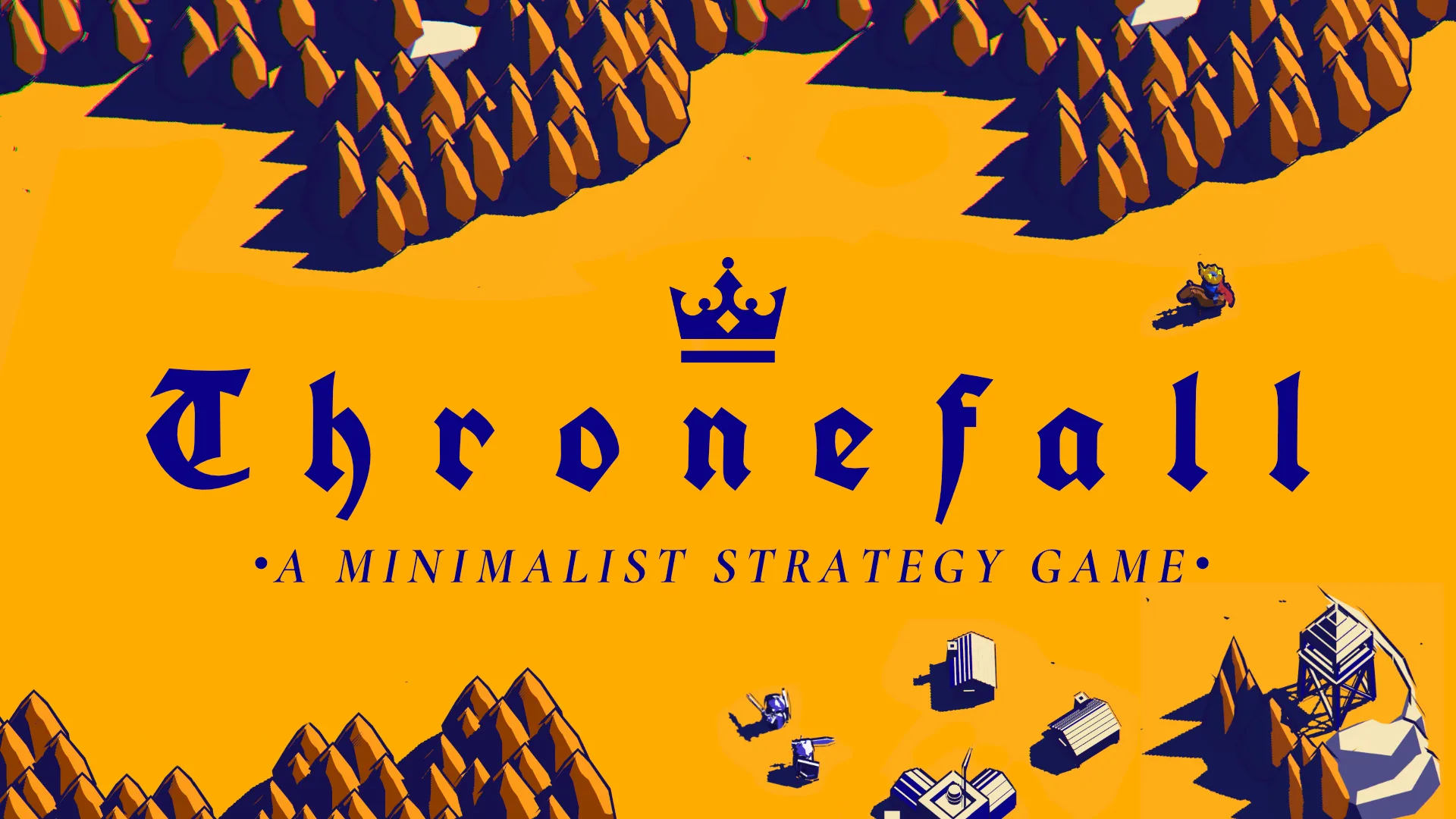
The Jonas Tyroller founder story is about an audience that showed up before the games did. He built a loyal YouTube following that turned two game launches into owned distribution. Before either game shipped, thousands of viewers had already watched the prototypes take shape, the mechanics get scrapped, and the design decisions get made in real time. By the time a game hit Steam, the launch had an audience that was already invested.
Tyroller is a Berlin-based developer who runs Grizzly Games with Paul Schnepf. The two met in the game design program at HTW Berlin and released Superflight in 2017 and Islanders in 2019 before Thronefall came along. Tyroller started his YouTube channel in 2018, around the time Islanders was completed, and he has used it to document his full-time indie dev journey ever since, mixing educational and entertaining game development content.
For Tyroller, documenting development is not a side project. It is the same work as building the games. The channel regularly reports on Thronefall’s development process, so viewers watch each design decision as it happens rather than reading about it after the fact. Every prototype, every failed mechanic, every late-night breakthrough lands on screen as it unfolds.
Since starting the channel, his released games include Islanders, Will You Snail? (a solo project), and Thronefall, plus a new project in development. That makes the channel and the work one continuous public record of indie dev building in public.
Will You Snail Was a Solo Game Built While the Channel Watched
Built entirely solo with Game Maker, the platformer’s core hook is an evil AI that predicts the player’s movement. The enemy knows what the player will do before the player does it, turning every level into a tense game of outsmarting an opponent one step ahead.
Because Tyroller documented the entire solo development on his channel, the audience did not discover the game at launch. They watched it take shape from early prototypes, following along as mechanics were tested, broken, and reworked on screen. By the time Will You Snail? shipped, thousands of viewers had been following the project for months or years, which meant the release day was less a cold debut and more a payoff for people who had been invested in the journey all along.
The game’s place in Tyroller’s catalog is confirmed in his own words. He hosts “A Game Dev Podcast With Jonas Tyroller,” and his intro states that he is behind the Steam titles Thronefall, Islanders, and Will You Snail. That framing treats the three games as a single body of work, with Will You Snail? standing alongside the more commercially prominent titles as a core part of his build-in-public portfolio.
No separate sales figure for Will You Snail? appears in the available sources, and Tyroller has not published a public number for the game on its own. The lack of a public number reflects the channel’s purpose. The channel’s role was to give the game a warm audience on day one rather than relying on store discovery to do the work. For a solo developer with no marketing budget to speak of, that owned audience was the launch strategy. The game’s real achievement was proving that the approach could work for a single developer working alone, with nothing but a YouTube channel and a camera between the work and the world.
How Thronefall Was Designed by Subtraction With Paul Schnepf
Thronefall is Grizzly Games’ third major title, and it shows how the studio’s build-in-public method scales to a two-person team. Jonas Tyroller handles balance, design, and new unit ideas while Paul Schnepf handles visuals, a division that keeps both halves of the game moving in parallel. The channel documented the whole process, so viewers watched the game’s core identity get decided in real time rather than presented as a finished concept.
That core identity almost did not exist. Thronefall was originally conceived as a deck-building card game, a direction that suited the studio’s history with smaller, systems-driven projects, but the team rebuilt the prototype in six hours around a different premise: building a kingdom and defending it. The pivot happened in view of the channel, with the audience watching the project shed its original form and take on the shape that would eventually reach players. Six hours is a short time to settle on a game’s direction, but the constraint forced a clarity that a longer, more cautious process might have muddied.
From there, the design philosophy became deliberate subtraction. Building placement is restricted to pre-defined slots rather than letting players drop structures anywhere, and purchasable resources are limited to one thing. The stated goal is reducing headaches for players and creators alike. Fewer decisions per minute means the player can focus on the defense puzzle instead of spreadsheet-style management, and the developers can design levels with confidence because they know exactly what the player can build and where. It is a stripped-down strategy game on purpose, not because the team could not build more complexity but because they chose not to.
Session length follows the same logic. Levels are designed to fit 20 to 30 minute sessions, a length chosen because the developers themselves had less time for long play sessions. Both Tyroller and Schnepf were working adults making games in their spare time, so the game they wanted to play was one that respected a busy evening. The result is a strategy game that can be finished in a reasonable sitting, which is itself a design statement in a genre known for sprawling campaigns and hundred-hour commitments.
Thronefall’s First-Year Success and the Channel as a Second Income
Thronefall sold over 1 million copies within its first year, and the early momentum was striking: in the first two months on Steam Early Access, it moved 315,000 units for over $1.5 million in gross revenue. Those figures put the game in a category that most solo and small-studio projects never reach, and they made the build-in-public experiment look less like a gamble and more like a template.
Pricing played its part. Thronefall launched into Early Access at $6.99, a deliberately accessible entry point for a strategy game that wanted players to try it without hesitation. The full release on October 11, 2024 raised the price to $12.99, and the game held attention with free updates every one to two months and occasional discounts, including a 20% markdown shortly after launch. That rhythm kept the game visible in storefronts and on wishlists long after the initial wave of coverage faded.
The audience followed the game beyond PC. The Android version, handled by Doghowl Games Ltd, shows an estimated 10,000 monthly downloads and roughly $40,000 in monthly revenue at $4.00 per download, with a 4.9-star rating from around 2,000 reviews. Those are estimates rather than official figures, but they point in a consistent direction: players who found Thronefall through the YouTube channel were willing to buy it again on another platform.
That brings up the income picture, and Tyroller has been unusually direct about it. He says he does not rely on his podcast for income and keeps it “relaxed with minimal monetization.” That statement matters because it clarifies where the money comes from. The podcast is a passion project, not a business. The YouTube channel itself is the revenue-generating public feed, and for an indie developer it works as both marketing and a second income stream. The videos that document development are the same videos that drive wishlists, sales, and ad revenue, which means the marketing budget and the production budget are one and the same.
That dual role is what makes the channel’s economics unusual. Most developers treat marketing as a cost center, something to spend on after the game is done. Tyroller’s approach folds the marketing into the development process itself, so every hour spent filming and editing is an hour that also produces content with its own monetization. By the time Thronefall shipped, the channel had already paid for itself through ad revenue while building the audience that would buy the game. The commercial success of Thronefall and the channel’s growth come from the same process.
The Real Cost of Building Games in Public
The tradeoff at the heart of building games in public is that nothing stays private. Every prototype, every pivot, every abandoned direction becomes part of the permanent record. That was especially visible with Thronefall, whose six-hour rebuild from a deck-building card game into a kingdom defense title happened only after the original concept had already been shown to the channel’s audience. Viewers watched the project shed one identity and take on another in real time, with no quiet reset or silent do-over. The transparency makes the approach compelling, but it also means the development process carries a level of exposure that most studios never have to think about.
The practical cost lands on time. Filming and editing regular devlogs amounts to a second full job stacked on top of programming, design, and balancing. Every hour spent in front of a camera or in an editing timeline is an hour that otherwise goes directly into the game itself. For a two-person team, that is a heavy tax on the actual production work. Tyroller and Schnepf chose to pay it because the channel was doing double duty as marketing, but the math only works when the audience the videos build is worth the production time they consume.
Designing in front of an audience adds another layer of difficulty. Feedback arrives constantly, from comment sections and community spaces, and much of it asks for more: more features, more systems, more complexity. The team had to hold onto the subtraction principle even when viewers suggested additions, because giving in to every suggestion would have eroded the very clarity that made Thronefall work. Staying disciplined under that kind of pressure is harder than it sounds, especially when the people making the suggestions are the same ones who will buy the game.
There is also a ceiling that a public project can eventually hit. Grizzly Games eventually sold the Thronefall IP to publisher Mythwright because the two-person team felt limited in how far they could push the game and wanted to move on to new projects. The sale is a reminder that a game built in public can outgrow its original creators, growing into something bigger and more commercially demanding than the small team that started it can sustain. That is not a failure of the approach; it is a consequence of its success, but it does mean the audience that watched the game being built may end up following it to a future the original team no longer controls.
What the Jonas Tyroller Founder Story Teaches Solo Devs
The reception data makes the case that the build-in-public approach delivered what it promised. Thronefall holds a 96% positive rating from over 20,000 Steam reviews and a Metacritic score of 92 from four critic reviews, which is roughly as strong a match as a game can get between what was shown and what shipped. The audience bought the game, and their reviews show they approved of what they had watched being built.
That approval was a long time in the making. The channel began in 2018, so by the time Thronefall entered Early Access in August 2023, viewers had followed the project through every stage, from the six-hour prototype rebuild to the public beta. Five years of documented decisions preceded the launch, which means no part of the game arrived as a surprise to the people most likely to buy it. They had already seen why the deck-building concept was abandoned, why building slots were restricted, and why session length was capped at 30 minutes.
The industry later confirmed the process. Winning Best Game Design at the 2025 German Computer Game Awards validates the design-by-subtraction philosophy that Tyroller documented step by step on the channel. That award recognizes both the game itself and the method that was visible to anyone watching, a rare kind of external proof for a process that usually happens behind closed doors.
The broader indie game launch strategy takeaway is straightforward: an audience built during development is launch distribution the developer owns. No ad budget can recreate six years of watched decisions, because no amount of spending can manufacture the trust that comes from watching a game find its identity in real time. A wishlist filled by people who watched the prototype fail is worth more than one filled by a banner ad, and the difference shows in day-one sales and long-term reviews.
But the trade is real. The same six years of watched decisions came at the cost of six years of filming, editing, and public critique, all layered on top of the actual development work. A solo founder has to decide whether that exchange fits their working style before committing to it. The approach only works if the developer is comfortable making mistakes in front of an audience, because the audience will see every one of them. For Tyroller, that discomfort was worth it. For a developer who prefers to iterate privately and show only finished work, the same strategy would be a poor fit regardless of how well it worked for him.
Build-in-public is not a shortcut or a guarantee. It is a specific working method with specific costs and specific rewards, and its results speak for themselves in Thronefall’s reception. The question for any solo founder is not whether the approach can work, but whether the developer can live with the terms of the deal.
Leave a Reply