
The Bennett Foddy founder story has two versions, and neither one looks like the other. On paper, he’s a moral philosopher who trained on the ethics of drug addiction, spent time as a postdoctoral researcher at Princeton University, served as deputy director of Oxford University’s Institute for Science and Ethics, and now teaches game design at NYU’s Game Center. In practice, he’s the person who made QWOP, a browser game where players try to run a 100-meter race by pressing alternating keys to control a pair of flailing legs, and Getting Over It with Bennett Foddy, a game in which a man in a cauldron climbs a mountain with a hammer and loses everything on a single slip.
Neither of those descriptions is wrong. Foddy, born in 1978, enrolled in a doctoral philosophy program at the University of Melbourne in late 2003, focusing on moral philosophy and drug addiction. Before that, he played bass in the electronic group Cut Copy, leaving in 2004 because, as he put it, the touring life of waiting and partying did not fit his personality. He taught himself to program and design games starting in 2006, working through online tutorials while writing his dissertation, and he later said that his best design work happened while procrastinating on other work.
His first Flash game, Too Many Ninjas, arrived in 2007 and drew coverage from Kotaku and Wired’s Game|Life blog. From there, the Bennett Foddy games catalog grew into a series of deliberately punishing experiences that became cultural moments years apart. The thread connecting them isn’t difficulty for its own sake. It’s a philosophy about what games are for, and a lesson for solo founders. His games succeeded by targeting a feeling rather than solving a need, and his academic background gave him a distinctive stance on why frustration might be worth building into a product.
Who Made QWOP and Why It Took Two Years to Go Viral

QWOP asks the player to do something absurdly simple on paper: control an Olympic sprinter’s thighs and calves using the Q, W, O, and P keys to complete a 100-meter sprint. The result is a body that flails, folds, and collapses in ways that look almost cartoonishly wrong. Released in 2008, it found a modest audience at launch and little more. The game sat in relative quiet for two years before the Internet decided it was one of the funniest things it had ever seen, and that delayed detonation is part of why who made QWOP became a question people actually asked.
The viral wave crested in late 2010, driven by Stumbleupon, Reddit, and YouTube. In an interview, he pointed out that when QWOP first came out in 2008, there wasn’t very much of a “Let’s play” culture. That culture had to be invented and strengthened before QWOP could take off as a viral hit. The game, in other words, was ahead of the distribution channel that would eventually make it famous.
When that channel arrived, it arrived through a specific video. A Let’s Play by Cr1t1kaL, a guy Foddy described as playing his game with a silly voice, a very deep voice, began circulating and reached larger YouTubers, including PewDiePie and Ray William Johnson. Each of those views compounded into the next, and QWOP became a touchstone of early YouTube comedy.
None of this was planned. Foddy has said plainly that QWOP was not created with streaming in mind. It was made for players in the privacy of their own home. That detail matters, because the game’s later follow-ups would be built with a very different audience in mind, one that QWOP’s own success helped create.
The Story Behind Getting Over It, the Game That Erases Your Progress
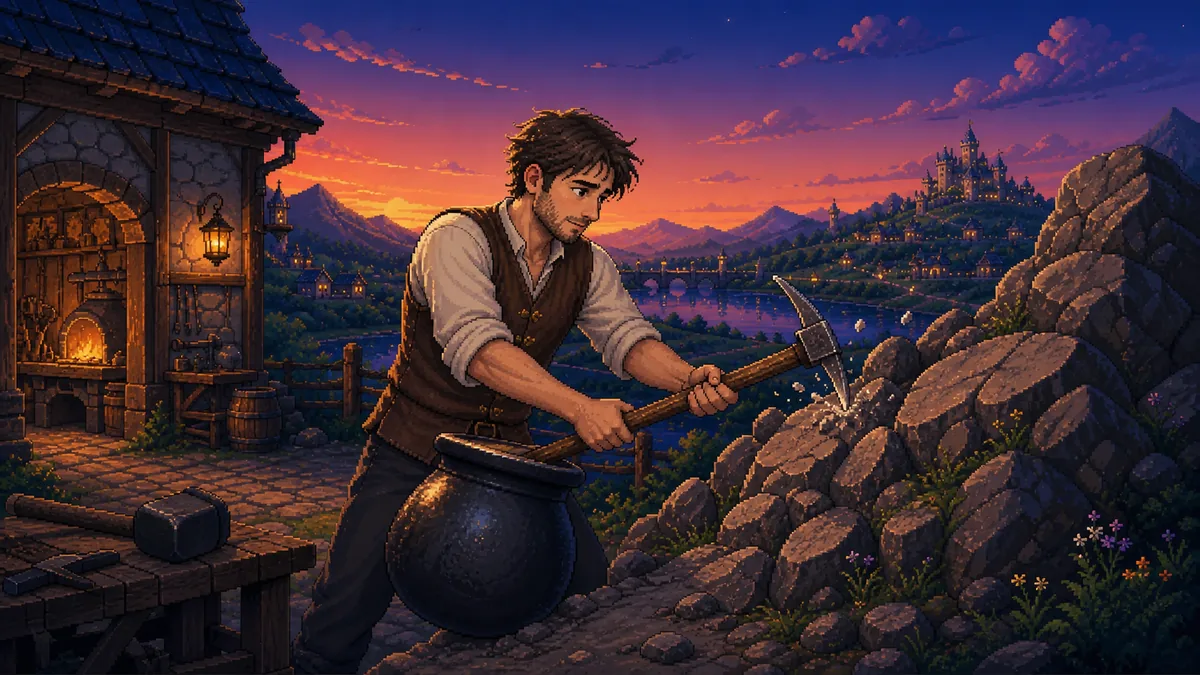
Getting Over It with Bennett Foddy is the rare game where the title itself is a confession. It arrived through Humble Bundle’s Humble Monthly on October 7, 2017, then hit Steam and iOS on December 6, 2017. The premise is almost insultingly simple: a man in a cauldron climbs a mountain using only a hammer, and the hammer is the only thing keeping him from sliding back down everything he has gained. The Getting Over It developer built something that takes the QWOP formula and compresses it into a single, unforgiving gesture.
The game has no checkpoints. There is nothing to save, nothing to fall back on, and no mercy built into the climb. A single mistake can erase an hour of progress, which is not an exaggeration or a marketing claim. It is the documented reality of how the game plays. Players who slipped near the summit did not lose a few minutes. They lost everything, and the game’s design made sure they felt it.
Foddy was not inventing this format from scratch. He built Getting Over It as an homage to Jazzuo’s 2002 free B-game Sexy Hiking, and he has described Jazzuo as a mysterious Czech designer known at the time as the father of B-games. Foddy’s own definition of the genre is telling: B-games are rough assemblages of found objects, built more for the joy of building them than as polished products. That framing matters, because Getting Over It was never trying to be a polished product in the conventional sense. It was trying to be honest about what it was.
The Steam page makes that honesty explicit. The description reads, “A game I made For a certain kind of person To hurt them.” It lists playtime as somewhere between 2 and ∞ hours, and adds that the median time to finish for Foddy’s playtesters was 5 hours, while the mean was closer to ∞. The median and the mean diverge precisely because some players never finish at all.
What separates Getting Over It from its predecessor in the Bennett Foddy games catalog is the narration. Foddy speaks throughout the climb, triggered by falls and progress alike, offering commentary that turns the experience into something closer to a guided meditation on failure. The Getting Over It story is not told through cutscenes or plot. It’s told through a developer who keeps talking to the player while they lose an hour of progress, quoting Friedrich Nietzsche, Emily Dickinson, Andrei Tarkovsky, and Ice-T along the way. The game’s cruelty is the medium, and the narration is the message.
How Streamers Turned Getting Over It Into a Viral Success
By the time Getting Over It arrived in 2017, Wired had already sized it up in two phrases that capture the whole experience: “uproariously, darkly funny” and “challenging to the point of impossibility.” Those two descriptions are not in tension. They’re the same design working on two audiences at once, and that split is exactly what made Getting Over It a viral success.
Foddy did not stumble into that audience the way he did with QWOP. He has said plainly that he started to think and talk about the idea of designing for spectacle, designing for the person who is waiting to play the game so that they can watch and draw some enjoyment from it. That’s a fundamental shift from the philosophy behind his 2008 browser game. QWOP’s virality was a byproduct of an emerging Let’s Play culture that Foddy admits barely existed when the game launched. Getting Over It was built with the spectator in mind from the start, which meant its failures had to be dramatic and watchable rather than merely punishing.
The difference shows in how each game treats a mistake. QWOP’s collapses are funny because they are chaotic and absurd, a body betraying its own operator in unpredictable ways. Getting Over It’s failures are funny because they are cumulative and specific, a single slip sending the player’s cauldron tumbling past landmarks they spent an hour earning. The former is comedy by accident. The latter is comedy by construction, engineered so that the person watching feels the weight of the loss almost as much as the person playing.
The game itself acknowledges this arrangement. At one point during the climb, Foddy’s narration observes, “Now I know, most likely you are watching this on YouTube or Twitch while some dude with 10 million views does it for you. Like a baby bird being fed chewed up food. And that’s culture too.” Foddy isn’t pretending the spectator dynamic does not exist or that it cheapens the experience. He’s folding it into the game’s subject matter, treating the act of watching someone else suffer through a mountain as its own kind of cultural ritual.
That awareness is part of why the game worked so well as a streaming property. Deliberately frustrating games have a natural advantage in front of an audience, because the emotional arc of rage, recovery, and eventual triumph is built into the gameplay rather than scripted. Getting Over It was popular with video game streamers for exactly that reason, and the recognition followed: it was nominated for the Independent Games Festival’s top prize and won the Nuovo Award for innovation and experimentation in 2018.
One game happened to be ahead of the distribution channel that would eventually make it famous. The other was designed, consciously and openly, for the channel itself.
Why Is Getting Over It So Hard? Foddy’s Design Philosophy in His Own Words

The voice that follows the player up the mountain is not flavor text. It’s the Bennett Foddy design philosophy spoken out loud, an essay delivered in fragments between failures. The game’s most revealing line comes early and quietly: “Most obstacles in videogames are fake; you can be completely confident in your ability to get through them… In that sense, every pixelated obstacle in Sexy Hiking is real.” The distinction matters. In a conventional game, a wall or a gap exists to be overcome, and the player knows the designer calibrated it to be passable. In Getting Over It, the obstacles were not tuned to accommodate anyone, and the game is honest about that difference. Foddy reinforces the point in the same breath: “The frustration is just essential to the act of climbing, and it’s authentic to the process of building a game about climbing.” Frustration isn’t a side effect of the design. It’s the design.
That stance explains why Getting Over It is so hard in the first place. Foddy has admitted he could have softened the climb and chose not to, reasoning, “I couldn’t bring myself to make it easier. It already felt like my inability to get past the new obstacle was my fault, as a player, rather than as the builder.” The logic is subtle. He doesn’t defend the difficulty as a test of the player’s skill or a gatekeeping mechanism. He defends it as a matter of authorship. The obstacle was placed, the player failed to cross it, and the failure belonged to the player, not to a designer who miscalculated. Lowering the difficulty would have meant retroactively declaring the player’s struggle illegitimate.
The narration turns that struggle into a philosophy of starting over. “Starting over is harder than starting up” and “There’s no feeling more intense than starting over” are not sympathy or consolation. They’re the game acknowledging that its own cruelty is the point. A checkpoint would have softened the emotional stakes, and the absence of one is what makes the losses land. When a player tumbles from near the summit, the game doesn’t apologize. It observes, “Oof, you lost a lot of progress. That’s a deep frustration, a real punch in the gut,” and then keeps climbing alongside them.
Foddy’s most personal commentary is reserved for why anyone would subject themselves to this at all. He frames the appeal in terms of taste rather than masochism: “An orange, a sweet juicy fruit locked inside a bitter peel. That’s not how I feel about a challenge. I only want the bitterness. Its coffee, its grapefruit, its licorice.” The metaphor refuses the usual framing of hard games as rewards wrapped in struggle. Foddy isn’t promising sweetness underneath. He’s saying the bitterness is the entire point, and he assumes the player shares that palate. “We have the same taste, you and I. It’s not ambition, it’s ambition’s opposite. An obdurate mission to taste defeat.”
That line is the closest thing to a thesis the game has. Ambition wants to win. This wants to experience losing and to keep going anyway. For a founder, the distinction is worth sitting with. Most products are built to remove friction, and most business advice treats frustration as a defect to be engineered away. Foddy built a product where frustration is the value proposition, and he explains that choice inside the product itself. The narration isn’t marketing wrapped around the game. It’s the game’s reason for existing, delivered by the person who made it, at the exact moments the player is most tempted to quit.
What Solo Founders Can Learn From Bennett Foddy’s Deliberately Frustrating Games

Getting Over It never claimed to solve a problem. It doesn’t organize, automate, connect, or save anyone time. What it does is create a specific emotional experience: frustration, failure, and the stubborn compulsion to try again. That’s the entire product. Foddy didn’t build a tool and then figure out how to make it entertaining. He built a feeling and let the audience find him. For a solo founder watching from the outside, that inversion is the most instructive thing about the whole Bennett Foddy catalog.
A product can target a feeling rather than a need, and the loyal audience self-selects because they want that feeling. Foddy never pretended his game was for everyone, and the players who finished it did so because the bitterness was exactly what they came for.
Designing for spectacle makes failures shareable, so “watchably difficult” becomes a distribution strategy without traditional marketing spend. Foddy built Getting Over It with the spectator in mind, and the streamers who collapsed, raged, and recovered on camera did the promotion for him.
Embedding philosophy directly in the product makes difficulty feel intentional and meaningful, which builds trust and understanding rather than backlash. Because Foddy explained himself inside the game, players interpreted the cruelty as authorship, not incompetence.
A product can be deliberately hard if that difficulty is honest, clearly signposted, and framed as the point. The Steam page’s “For a certain kind of person” wasn’t a warning to scare people off. It was an invitation to the people who would stay and evangelize the game because it respected their taste.
The takeaway for any solo founder isn’t that difficulty should be copied, but that the relationship between a product and its audience can be built on something other than convenience. A product that is honest about what it is, and what it demands, will repel the wrong users and keep the right ones close. The question worth asking is not what need a product fills but what feeling it creates. Foddy’s answer was frustration, and it made him famous twice, a decade apart.



Leave a Reply