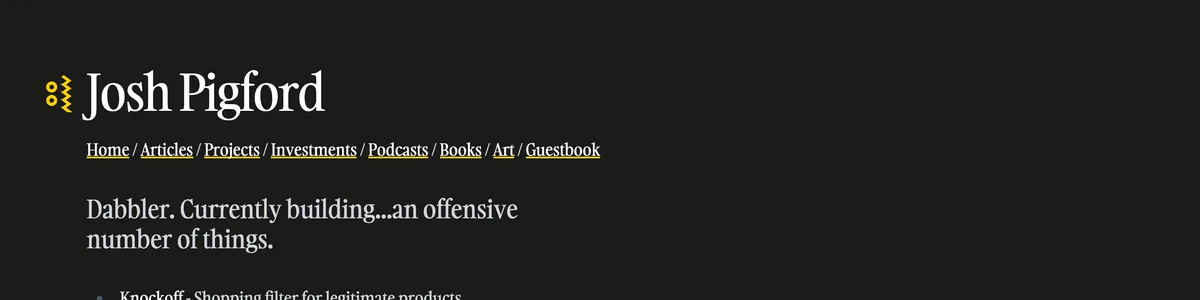
Josh Pigford has shipped 94 projects since 2003 and sold Baremetrics for $4 million in November 2020, then kept building. The Josh Pigford founder story covers that whole run, from the small sites he sold along the way to the Baremetrics exit and the products he ships now.
Pigford has tracked those 94 projects on his site since 2003, covering roughly 20 years of making stuff: small apps, SaaS tools, and experiments, most of which went nowhere. He’s been self-employed for essentially all of his adult life, with only a 7-week lapse right out of college, and did design and development consulting for Adobe, AOL, Dell, Groupon, Warner Bros, and a 2008 presidential candidate’s website along the way. Long before Baremetrics, he sold TheAppleBlog to Gigaom for $75,000 plus a salaried job for two years, and Om Malik called him a “starter,” a label Pigford says resonated.
Baremetrics, his best-known project, sold for $4 million in cash to Xenon Partners, a tech private equity firm, in November 2020. The deal came after years of building in public, publishing revenue numbers, and surviving the kind of rough patches most founders keep quiet about.
This is the story of how a serial starter used transparency to grow a SaaS and sell it on his terms. It also traces the whole build-grow-sell-restart arc: the many small projects that went nowhere, the transparency that helped Baremetrics grow, the hard middle, the sale, and the restart that followed.
Where the Josh Pigford Founder Story Starts

Before Baremetrics, Pigford ran survey SaaS PopSurvey and Temper. PopSurvey made nothing, and Temper never became a breakout product either. Yet the pattern was already visible: build something, ship it, see what happens, and move on when it doesn’t take off. The small exits along the way tell that story in dollar figures.
ReallyFunArcade sold for $4,500.
Tutorial Outpost sold for $19,000.
Fugitive Toys sold for $26,000.
LinkScout sold for $25,000.
NameSnag sold for $15,000, just eight days after launching.
Adregate sold for $10,000 before it even launched.
None of these were life-changing numbers, and most were dead ends rather than stepping stones. But they built the habit of shipping and the confidence that a solo founder could take an idea from concept to a paying exit without a team or outside funding.
Baremetrics started in October 2013 because Pigford couldn’t easily see his own Stripe revenue metrics. He was running his own businesses and wanted a clear view of recurring revenue, churn, and the other numbers that matter to a subscription company, and Stripe’s built-in reporting wasn’t giving him that. So he built the first version himself in about 7-8 working days and launched it in November 2013.
The first paying customer arrived within 8 days of the idea, signing up for the $250/month plan with no free trial in the early days. Within two months, Baremetrics passed $2,000 MRR, and within six months it was climbing toward $14,000 to $16,000 MRR. For a tool built in a week and a half by one person, that kind of pull suggested he had found a real gap in the market.
Publishing His Own Revenue Dashboard and What Transparency Did for Growth

Baremetrics has made its own metrics public since 2014 at demo.baremetrics.com, showing live revenue, MRR, churn, and the rest of the SaaS numbers most founders guard closely. Anyone could watch Pigford’s business fluctuate in real time, which was an unusual level of exposure for a young company built by one person in a week and a half. The move turned a Stripe analytics tool into something more: a demonstration of the product’s own value, running on its own data.
Buffer followed after a dinner conversation with Hiten Shah, a Buffer advisor, at MicroConf. Buffer was doing about $250,000 a month at the time and decided to publish its own numbers on buffer.baremetrics.com. The company later passed $1,000,000 a month and became a flagship open startup, proof that the approach to transparency could scale well beyond a solo founder’s experiment.
In April 2015, Pigford launched Open Startups with seven founding members:
Baremetrics, the host startup.
Buffer, the social media scheduling tool that made openness a core part of its brand.
ConvertKit, the email marketing platform for creators.
Ghost, the open-source publishing platform.
Hubstaff, the time tracking and productivity software.
Promoter, the customer feedback tool.
StoreMapper, the store locator service.
The initiative gave public metrics a name and a home. Over 125,000 entrepreneurs followed the open data from those seven startups, turning what had been a single founder’s bold choice into a movement other builders could model themselves after.
Around 2016, Pigford launched Open Benchmarks, which aggregated live, anonymized benchmarks from over 600 SaaS companies using Baremetrics, grouped into cohorts by average revenue per user. The goal was to give founders a realistic sense of how their numbers compared, rather than the highlight reels that dominate startup culture. Pigford put it plainly: he wanted to ‘break down the ‘Yeah bro!, hockey stick growth!’ mentality that was so prevalent in startup culture.
The Hard Middle: Near-Death Moments and the Deal That Fell Apart
The transparency made Baremetrics a compelling story, but the story behind the dashboard was far messier than the public numbers suggested. In June 2015, Pigford realized the company had only a few weeks of cash left in the bank. He responded with eight months of pay cuts and team changes, cutting costs while the business kept climbing. The discipline worked: Baremetrics grew through that stretch, restored full pay, and eventually became profitable.
Growth came in fits rather than a steady line. Baremetrics hit several plateaus, including a stretch where it sat stuck at $30,000 MRR for six months. The pattern repeated in 2020, when the company hired three new team members to start the year and then COVID hit. March was rough, but the months that followed turned out to be some of the best growth months Baremetrics had ever seen.
The near-death moments weren’t limited to cash flow. Around April 2019, Pigford received an offer for about $5 million. It looked like the payoff for years of building in public, but the terms undercut the headline number: the deal was structured as an asset sale rather than a stock sale, which would have carved away nearly 50% of the purchase price. He declined.
Another offer took a different kind of toll. Pigford spent six months and close to $20,000 in legal fees on due diligence for a deal, only for the buyer, who had misrepresented their funding, to ghost him days before closing. Other offers came in ranging from $1 million to $4.5 million, and none of them made sense. The failed acquisition attempts stacked up, each one teaching him something about what a real deal needed to look like.
By the time a serious buyer appeared, Pigford had already survived a cash crunch, a global pandemic, and multiple dead-end negotiations. He knew exactly what he was willing to accept.
The 2020 Sale to Xenon Partners and the $4 Million Exit
Baremetrics sold for $4,000,000 in cash to Xenon Partners in November 2020. Pigford walked away with $3,700,000 in cash, with $300,000 paid out to the team, and the deal closed just six weeks after receiving the letter of intent.
The price worked out to roughly 2.65x ARR, with about $1.5 million in annual recurring revenue and roughly 1,000 customers at the time of sale. Baremetrics was running on a team of about 10 people, a lean operation by any standard for a company generating that kind of revenue.
The structure of the deal reflected how much Pigford had learned from the offers he’d turned down. The payment came in three installments, at close, 12 months out, and 18 months out, with no earnout attached. Xenon also guaranteed Pigford would take home $3.7 million regardless of what came up during due diligence, a protection that directly addressed the pain of the earlier deal that collapsed days before closing.
The investors who had backed Baremetrics years earlier made the deal possible in a way that rarely happens. General Catalyst and Bessemer, who had invested $800,000 in seed funding in 2014/2015, agreed to write off their investment rather than recoup it so the $4M exit could proceed. General Catalyst’s response to the outcome was gracious: “We recognize the work that’s gone into the past 7 years and it sounds like this is a great landing spot for the team.”
The tax treatment added another layer to the outcome. Pigford paid almost zero capital gains tax on the proceeds through qualified small business stock (QSBS), a provision that let him keep nearly the full amount rather than handing a significant slice to the IRS. He was also clear about why he wasn’t interested in the kind of earnout-heavy deal that would have tied him to the company for years: “The prospect of sticking around for years to actually get the payout was soul-crushing and I just wasn’t interested.”
This was a clean, intentional exit that stood in contrast to the earlier failed deals. Those earlier attempts had involved a buyer who misrepresented their funding, an asset-sale structure that would have carved away half the price, and six months of legal fees evaporating into nothing. This one closed in six weeks, with the team taken care of and the founder free to move on.
Life After the Sale and What Solopreneurs Can Learn
The day after the deal closed, Josh Pigford wasn’t celebrating on a beach. He jumped straight into running a laser cutter 12 hours a day and packing orders for the holiday shopping season, then said he wanted to make “more tangible things, especially art and music.”
The software break didn’t last long. He later co-founded Maybe, a B2B forecasting and scenario planning tool, shut it down, and open-sourced the entire codebase in February 2024. Rather than letting the project die quietly, he gave the code away, a move consistent with someone who has never treated a shutdown as a dead end.
Today, Pigford is shipping five AI products at once, alongside a handful of other ongoing projects:
ReplySocial, an X mentions inbox.
Rumored, a tool that detects and fixes false AI claims.
Rerun, a Mac app.
Chops, an AI agent skills manager.
InitialCommit, a fractional AI co-founder for startups.
Knockoff, another project in rotation.
Granite, another ongoing build.
KeptWell, another project on the list.
Super Fantastic, another in the current lineup.
Initial Commit, the same product as InitialCommit, with the spacing varying across Pigford’s own published descriptions.
Pigford tracks 94 projects since 2003 and continues to start things, sell some, and move on without treating any single outcome as final. Baremetrics was the biggest win, but it was never the point. It was one chapter in a longer habit of building that predates it and continues well past it.
For solopreneurs watching this arc, a few lessons stand out:
Transparency gave Baremetrics over 125,000 entrepreneurs following its open data by 2015, and the Buffer partnership started from a dinner conversation. Openness compounds trust in ways that paid advertising rarely can, turning customers into observers and observers into advocates.
Selling for $3.7 million after investors wrote off $800,000 shows an exit can be clean and intentional. Selling is a legitimate ending for a business, not a failure to hold on longer than makes sense.
Shipping many small things, even when most go nowhere, builds the reps that make a big hit possible when the right idea comes along.
The takeaway is not that anyone should copy Pigford literally. Not everyone can sustain a decade of small projects waiting for one to land, and not every founder wants to publish their revenue for the world to watch. But the broader shape of his career is worth holding onto: starting many things, building in public, and treating any single sale as one step rather than the finish line can be a sustainable way to build a career. The 94 projects since 2003 are the real story. The $4 million exit was just the loudest chapter in it.


Leave a Reply