
The Derek Yu founder story starts with freeware. He turned a side project released for nothing into a genre-defining game, and then published a practical set of rules for finishing projects.
Born July 2, 1982, in Pasadena, California, Yu started making games as a kid. He later went to school for programming while developing his artwork independently, building a skill set that would serve him across both the technical and visual sides of game creation. His first major released game was Eternal Daughter, a freeware title he made with Jon Perry. Yu began work on it near the end of high school in 2000, assuming it would be finished over the summer before college; it took two years to complete.
That early experience shaped the philosophy he would carry into every project after it. In his book Spelunky, Yu distills his approach to a core rule: “Finishing games gets easier with each game you finish, and the more games you finish, the better you will understand what it takes to make a successful game.” It is a simple observation, but it runs against the grain of how many people approach creative work, treating each unfinished project as a fresh start rather than a lesson banked. For Yu, every completed game, even a small freeware release, compounds into the next one’s foundation.
Derek Yu’s Early Freeware Roots and the Making of a Developer
Long before Spelunky existed, Yu was already deep in the freeware scene, a corner of game development where creators released work for nothing and built reputations through community word of mouth rather than marketing budgets. Eternal Daughter, the project he started near the end of high school with Jon Perry, was his first real statement in that world. The two released it in 2002 under a label they formed together called Blackeye Software, after two years of on-and-off development that stretched well past the summer Yu had expected it to take.
The game itself was built in Multimedia Fusion, a more advanced version of the Klik & Play engine that many hobbyist developers of that era cut their teeth on. Yu was not working with a studio budget or a proprietary engine. He was using accessible, even playful software that let a young programmer with an art background move between code and visuals without friction. Eternal Daughter was a freeware release, which meant it traveled through the same channels as other indie experiments of the time. It went through forums, download mirrors, and the quiet buzz of players passing it along.
Around that same period, Yu met Alec Holowka while working on “I’m Okay – A Murder Simulator,” a project built around a brief from Jack Thompson, the lawyer whose crusade against violent games made him a frequent figure in gaming discourse. In 2007, Yu and Holowka co-founded Bit Blot to develop and self-publish Aquaria, a hand-drawn underwater adventure that became Yu’s breakout critical success.
Aquaria launched on December 7, 2007, through direct download and select digital storefronts. It went on to win the Seumas McNally Grand Prize at the Independent Games Festival, with finalist nods in Technical Excellence and Design, and eventually passed 213,000 units sold for roughly $1.5 million in gross revenue. Those numbers look modest next to what Spelunky would later achieve, but they proved something important. A freeware developer could build a paying audience, win industry recognition, and sustain a career on original ideas.
The Freeware Spelunky and Its Roguelike Core
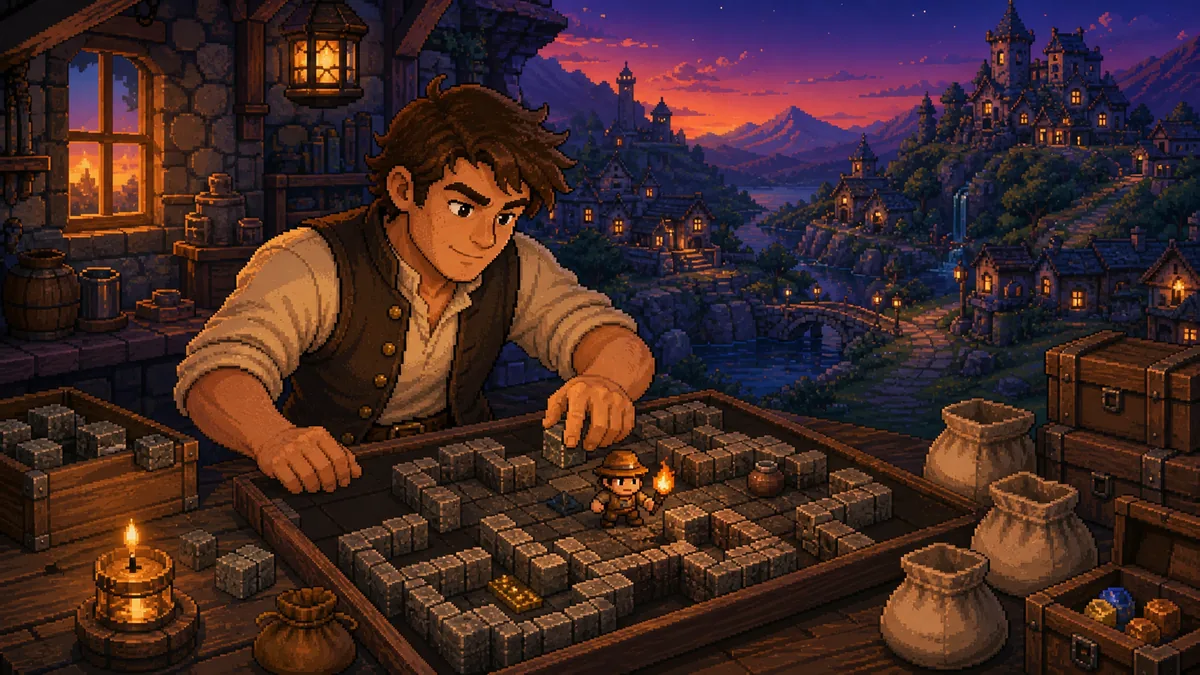
Spelunky Classic arrived on December 21, 2008 as a freeware release for Microsoft Windows, built in GameMaker. Yu handled every aspect of development himself, with the exception of the music, which was composed by Usagi Buzinkai and Jon Perry. The game dropped into the world with no price tag and no publisher, carrying only the weight of what it actually was: a platformer that borrowed the punishing structure of a roguelike and made it feel natural.
The mechanics that defined the Spelunky roguelike formula were all present from that first freeware build:
Levels assembled through procedural generation from a pool of modular rooms
Permadeath that ended a run at the first fatal mistake
High-difficulty traps designed to punish careless movement
Destructible terrain that made every environment a tool as much as an obstacle
Inventory management that forced real choices about what to carry and what to leave behind
That combination was unusual in 2008. Procedural generation had been a staple of roguelikes for decades, but fusing it with the tight, moment-to-moment physics of a platformer created something players had not quite felt before. Every run was a fresh layout, which meant memorizing a single path would never be enough. The player had to learn the game’s systems rather than its level order. Permadeath made each mistake permanent, raising the stakes of every jump and every trap triggered.
Yu released the source code for the 2008 Windows version on December 25, 2009, under a license that permitted noncommercial distribution and modification. The community responded with mods and a Mac OS X patch, extending the game’s reach beyond its original platform. It was a generous move that fit the freeware spirit of the release, and it kept the game alive in players’ hands long after its initial launch.
The design philosophy underneath it all was stated plainly in a 2009 interview: “rewards in games are only as satisfying as the challenges are hard.” That single line explains why Spelunky never felt cruel despite its difficulty. The game was not punishing for its own sake. It was calibrating the player’s sense of achievement. Every treasure chest, every shortcut discovered, every level cleared landed harder precisely because the path to it was so unforgiving.
The TIGSource Feedback Loop and Why Releasing It Free Mattered
The first version of Spelunky did not arrive with a marketing push or a launch window. It was posted directly to the TIGSource forums, where players could download it, play it, and respond within hours. That immediacy created a development loop that shaped the game as much as any design decision Yu made in isolation. Bugs surfaced fast, ideas got tested against real reactions, and the community’s enthusiasm told Yu which mechanics were landing before he invested months in polishing them. A public version followed shortly after, widening the circle of players who could feed into that cycle.
Distribution stayed entirely in Yu’s hands. The game went out through a TIGSource announcement and his personal website, with no paid marketing and no publisher involved. That meant every download was earned by word of mouth, and every piece of feedback came from someone who had actively sought the game out. The freeware model was not a compromise or a stepping stone for Yu. It was a deliberate strategy. As he put it, “It’s such a great way to get your ideas out and see what sticks before you go into the pressure cooker that is commercial game-making.” Releasing work for nothing let him test the concept, iterate on what players responded to, and build a foundation of goodwill before any commercial stakes entered the picture.
That free release ended up doing more than any marketing budget could have. It caught the attention of Jonathan Blow, whose own trajectory through indie development gave him a sharp eye for original design. More consequentially, it reached Microsoft, which would later become the platform holder for the game’s commercial remake. And it pulled in Andy Hull and Eirik Suhrke, two developers who would go on to work closely with Yu on the 2012 Xbox Live Arcade version of Spelunky. The freeware release had its own wiki and a community of modders building on the source code Yu shared, all of it organically assembled around a game that cost nothing to play. By the time Spelunky was ready for a commercial release, it already had an audience that knew exactly what it was getting.
From Freeware to Xbox Live Arcade and a Commercial Release
For years, Yu treated Spelunky as a freeware project and nothing more. The game’s success in that space was real, but it did not push him toward a commercial version. He did not seriously consider expanding beyond freeware until Jonathan Blow, whose own indie breakthrough had made him a respected voice in the scene, offered to put him in touch with Microsoft. That single connection shifted the trajectory of the game entirely.
The result was Spelunky HD, which launched on Xbox 360 via Xbox Live Arcade on July 4, 2012. The commercial release was not a quick port of the original. It was a full remake built from the ground up. Yu programmed the XBLA version in Visual Studio, a significant departure from the GameMaker environment that had produced the 2008 freeware original. That shift in tooling reflected the larger change in scope: the remake was a bigger game, with more content, more systems, and a level of polish the freeware version never had.
He spent about two years on the freeware version and two more on the XBLA remake, roughly four years total on the game across both iterations. The difference was that the second two years were more full-time. The first pass at Spelunky happened around the edges of other work and life. The remake became the job itself. That commitment is part of the Spelunky history that tends to get flattened in retellings, where the game appears to spring fully formed from a single burst of creativity. In reality, it was four years of iteration across two distinct development cycles, each with its own constraints and tools.
The XBLA release also brought in collaborators. Yu worked with Andy Hull and Eirik Suhrke, the two developers who had come to the game through its freeware release, on the remake’s music and sound. The commercial version was still unmistakably Yu’s game, but it carried the fingerprints of a small team rather than a solo developer working alone in GameMaker.
What made the commercial release notable was that it did not abandon the freeware roots that had built the game’s audience. The 2008 original remained free and available, and the community that had formed around it carried over into the paid version. By the time Spelunky HD arrived on Xbox Live Arcade, it was not introducing players to an unknown quantity. It was giving an existing fanbase a more polished version of a game they already loved, while introducing that same game to a much larger console audience. The commercial release deliberately expanded from freeware to a paid model, keeping the freeware roots intact.
How Spelunky HD Added Features and Became a Genre Blueprint
The Xbox Live Arcade remake of Spelunky, which launched on July 4, 2012, rebuilt the game’s systems and presentation from the ground up, turning a beloved niche experiment into the clearest expression of what a platformer roguelike could be. Where the 2008 version had been a solo effort in GameMaker, the remake arrived with HD visuals, refined physics that let players push items with a whip, new enemy types, hidden secret areas, four-player local co-op, and global online leaderboards that gave the game’s permadeath runs a competitive edge.
The PC port launched August 8, 2013 on Steam, GOG.com, and Mossmouth’s direct sales channel, with PS3 and PS Vita versions following later that month. A PS4 port arrived October 7, 2014, and Xbox One players got access through backward compatibility in December 2015. By 2016, cross-platform sales had exceeded one million units, a number that would have been unthinkable for the freeware original’s download counts.
The critical recognition matched the commercial momentum. Spelunky took home the IGF Excellence in Design award in 2012 and earned nominations in three categories at the Independent Games Festival, including the Seumas McNally Grand Prize. That award season did more than validate the game. It positioned Spelunky as the reference point for an entire wave of games that would follow its template.
The combination of procedural generation, permadeath, and tight platforming physics that Yu had pioneered in 2008 became the genre blueprint for a generation of games. Titles released in the years after Spelunky HD borrowed its structure wholesale: randomized levels, run-based progression, and the tension of losing everything on a single mistake. The game popularized the platformer roguelike and defined what players expected from the form. Its influence is visible in nearly every game that has claimed the label since.
Derek Yu’s Book and His Warnings About the Death Loop
In 2016, Derek Yu published his own account of the game’s creation. Spelunky, released through Boss Fight Books in Los Angeles, was the first entry in the publisher’s series written by the game’s creator himself, a format that has since become a hallmark of the line. Rather than a memoir or a design retrospective, the book reads as a working manual for anyone trying to ship creative projects, with Yu’s own development history as the case study running through it.
The book’s most useful concept is what Yu calls the death loop. It describes the trap that swallows so many developers: a project that is functionally complete but never quite finished, because the creator keeps finding reasons to polish, tweak, and improve rather than release it. “We actually don’t want to release,” he writes, because “the release of a game is also the moment of judgment and of reckoning… there is comfort in continuing to work and make improvements, grinding against familiar problems behind-the-scenes.” The polishing loop, in other words, is not really about the game at all. It is a way to delay the moment when the work has to stand on its own.
Yu’s advice for escaping that loop is practical rather than philosophical. On scoping, he argues that “the best metric for scoping a project is not technical skill, but the scope of the previous games you’ve finished!” The point is that ambition should be measured against demonstrated output, not against what a developer believes they can handle. A game that looks twice as large as the last completed project is already a risk, regardless of how much the creator has learned since.
His second rule concerns when to polish. “Save most of the polishing for the end,” Yu advises. “I find it best not to spend too long on any one part of the game until the entire game is playable from beginning to end.” That sequencing keeps a project honest. A game that is playable start to finish, even in rough form, is a game that exists. A game with one beautifully polished level and nothing behind it is a collection of assets waiting to become a death loop. The freeware Spelunky shipped with rough edges, and the commercial remake was a separate, deliberate effort years later. Neither version waited for perfection before reaching players.
Scaling Beyond Solo with Spelunky 2 and a Larger Team
Spelunky 2 marked the point where Yu stopped working as a solo game developer and started running a studio. Development began around 2016 under Mossmouth, with Yu still serving as lead designer and lead artist, but the sequel’s scope made clear from the outset that this would not be another solo effort. The game needed online multiplayer, a larger world, and more systems layered on top of the original’s tight core, and none of that was realistic for one person working alone.
The clearest sign of that shift was the partnership Yu formed with BlitWorks, the studio that had handled the first game’s PlayStation ports. BlitWorks took on programming for Spelunky 2, and Yu was direct about why that mattered. Their involvement was “an absolute requirement” for meeting fan expectations. He put it plainly: “In order to make a bigger game and let people play online… it definitely required a larger, more experienced team.”
The expansion went beyond programming. Spelunky 2 was the first game in the series where Yu asked another artist to contribute illustrations, bringing in Justin Chan to help with the visual work. It was a small concession on paper, but a meaningful one for a developer who had carried the art duties alone through two games and a freeware release.
Spelunky 2 launched on PS4 on September 15, 2020, followed by Windows on September 29, 2020. Later ports extended the game’s reach across Nintendo Switch, Xbox consoles, and eventually PS5. The PC version averaged 91 on Metacritic, the highest critical reception of the series and a sign that the larger team had not diluted the design that made the original work.
Yu’s own framing of the sequel’s development is revealing about how he handled the transition from solo developer to team leader. “I felt a lot less pressure working on Spelunky 2,” he said. “Spelunky 1 would always exist no matter what we did to it… The team was larger and more experienced – we weren’t just three people making our first console game.” That confidence came from having already proven the core idea once, and from trusting a larger team to carry parts of the load he had once handled himself.
Derek Yu’s Rules for Finishing a Game and Escaping Abandonment
Yu’s advice for how to finish a game starts with a reframing of the goal itself. “My advice is to abandon the goal of making an objectively great game,” he writes. “Instead, focus on making the best game you can at the time and find joy in your personal growth.” An objectively great game is a moving target, one that depends on audience reaction, industry trends, and comparisons to work that did not exist when development began. A best game you can make at the time is something a developer can actually control.
That framing feeds directly into the long-term mindset Yu recommends for anyone serious about finishing projects. “Look beyond this one game,” he advises, “reminding myself that the game I’m currently working on is part of a long chain of games.” The perspective matters because it changes what a release means. A single project stops being the test of a developer’s entire worth and becomes one link in a sequence, a step that makes the next one possible. Yu’s own career demonstrates the principle in action: the freeware Eternal Daughter taught him what a completed project felt like, the 2008 Spelunky tested a new genre fusion, and the commercial remake proved the idea could carry a paying audience. Each release fed the next.
On the question of when a game is actually done, Yu borrows a line from the French painter Paul Valéry: “A work of art is never finished, only abandoned.” The point is not that developers should rush their work out the door, but that the moment of release is always a decision rather than a discovery. No amount of polish will make a game feel truly complete to the person who built it. At some point, the creator has to choose to let it go. Yu tells developers to trade “death loops for a circle of life – where one project begets another in a natural and healthy timeframe.” Releasing a game, even one with rough edges, puts that project in the ground and makes room for the next one to grow.
The risk of falling back into a death loop grows the longer development stretches on. “The threshold for success goes up the more resources you invest in your game,” Yu notes, “and the longer development goes, the greater the chance of falling into a death loop of some kind.” It is a counterintuitive warning, because most developers assume that more time and more investment means a better result. Yu’s point is that the opposite happens: every extra month raises what the game has to achieve to feel worth the effort, which raises the temptation to keep polishing rather than release. The game that shipped on time and found its audience was, in Yu’s telling, the one that respected the limits of its own scope.
Taken together, these rules form a coherent philosophy for releasing games. Set the bar at what is achievable now, understand the current project as part of a longer arc, accept that finishing means abandoning, and watch the resource investment before it quietly raises the stakes. None of it is glamorous advice, and none of it promises that the finished game will be a hit. It promises something more useful: that the developer will finish, learn, and have a foundation for the next project to stand on.
What the Derek Yu Founder Story Means for Solopreneurs
In 2009, Yu established Mossmouth, LLC as a solo independent studio, formalizing what had until then been a one-person operation. The move marked his shift from freeware releases to monetized titles, and it is telling that the company began with a single employee: Yu himself. Mossmouth was not a studio in the conventional sense at its founding. It was a legal structure around a developer who had spent years proving he could ship games on his own terms.
The company’s trajectory maps cleanly onto the advice Yu has given about scope and sequencing. He is explicit that the freeware-first path was not a detour but a necessary stage. “Had I attempted to go straight for Spelunky 2,” he wrote, “the road would have been many times more challenging, stressful, and uncertain.” The statement is a direct rebuke to the instinct many founders share: skip the small proof, go straight for the ambitious product, and assume the extra risk is worth it. Yu’s own history suggests otherwise. Each release, from Eternal Daughter to Spelunky Classic to the commercial remake, built capacity that the next project leaned on.
That perspective extends to how Yu thinks about failure. In a March 2025 tweet, he argued that games can teach that “failure is not only ok, but necessary for growth.” It is an unusual position for a designer whose games punish small mistakes harshly, but it is consistent with how he has run his career. The freeware release that could have flopped quietly instead became a genre blueprint. The commercial remake that could have alienated the freeware audience instead carried the game to over a million sales. Each step carried real risk of failure, and each step was taken anyway.
For solo founders, the lesson in Yu’s career is not about game development specifically. It is about the value of shipping something, however small, and letting it go. Yu’s own framing of his identity captures the stance precisely. “I’ve started to think of myself, personally, as a ‘work in progress’ that will never reach completion – but in order to keep progressing, I have to release games.” The sentence is the entire philosophy in miniature: the work is never done, the person doing it is never done, and the only way forward is to release, learn, and release again.
The indie game founder story behind Spelunky is not a tale of a single brilliant stroke. It is a record of incremental releases, each one a link in a chain that stretched from a freeware experiment to a genre-defining franchise. Yu did not wait until he was ready to make Spelunky 2. He made the games that made Spelunky 2 possible, and then he let each one go so the next could exist.
Leave a Reply