ConvertKit and Kit are the same platform. ConvertKit rebranded to Kit in 2024, keeping the same product, the same account system, and the same team behind it. Older ConvertKit tutorials and reviews still describe the current platform accurately, so anyone comparing the two is really looking at one tool with two names.
That naming clarity matters because ConvertKit vs beehiiv vs MailerLite isn’t a question of brand recognition. It’s about which of three genuinely different free starting points fits a newsletter’s growth path: Kit’s 1,000-subscriber free tier, beehiiv’s 2,500-subscriber free tier, and MailerLite’s 250-subscriber free tier. The deciding factor is the free ceiling, not the feature count on paper.
On this page
- Three Free Tiers Compared: 250 vs 1,000 vs 2,500 Subscribers
- What Kit Is Built For: Selling Directly to Your Readers
- What beehiiv Is Built For: Publishing and Growing an Audience
- What MailerLite Is Built For: Affordable Email with Full Testing
- How ConvertKit vs beehiiv vs MailerLite Pricing Scales
- Monetisation: Ad Networks, Recommendations, and Paid Subscriptions
- Deliverability and Free-Plan Sending Caps
- The Migration Question to Ask Before You Start
- Which Platform to Choose Based on How You’ll Use It
Three Free Tiers Compared: 250 vs 1,000 vs 2,500 Subscribers

Among these three free newsletter platforms, the subscriber ceiling creates the biggest practical difference. Kit, beehiiv, and MailerLite each offer a genuinely free starting point, but the room each gives a list to grow before the first bill arrives varies by a factor of ten. The subscriber headroom matters more than any feature list early on.
| Platform | Free subscriber ceiling | Key limits & notes |
|---|---|---|
| Kit | 1,000 subscribers | Newsletter tier, free for up to 1,000 subscribers, includes limited automations and one basic visual automation |
| beehiiv | 2,500 subscribers | Launch plan, free for up to 2,500 subscribers, the largest free ceiling of the three |
| MailerLite | 250 subscribers | Free plan, up to 250 subscribers, 2 user seats, with a 14-day trial of premium features |
A free ceiling of 250, 1,000, or 2,500 subscribers determines how long a list can grow before the platform asks for payment.
What Kit Is Built For: Selling Directly to Your Readers

Kit is built around a different question than most email platforms. Most email platforms help a newsletter grow into an ad-supported media property. Kit takes the opposite approach: it is built for creators who sell directly to readers, using landing pages and tags.
That positioning shapes everything from the pricing structure to the feature set. The two tools serve different ambitions even though both start free.
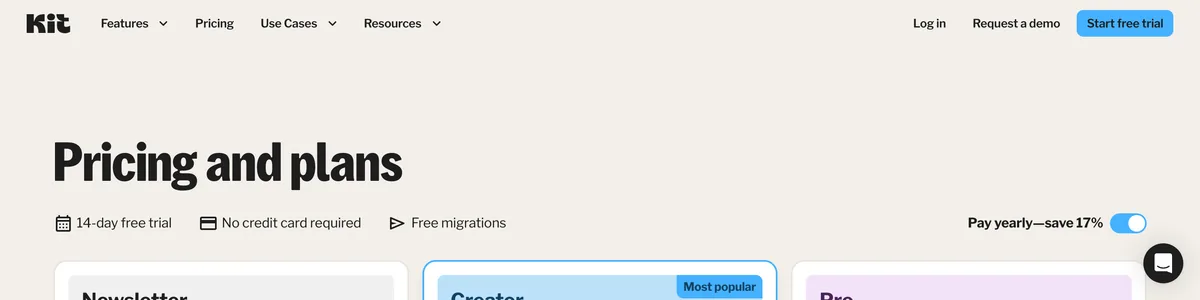
The pricing reflects that creator-commerce focus. Kit Creator runs $33/mo at 1,000 subscribers, or $390/year, which saves $78 over monthly billing. Stepping up to Kit Pro costs $66/mo at the same subscriber count, or $790/year, saving $158. Either way, yearly billing knocks 17% off the total. A 14-day free trial requires no credit card, and migrations are free, which lowers the risk of switching from another platform.
Every Kit tier includes audience tagging and segmentation, so a creator can sort readers by interest, purchase history, or engagement and send each group a tailored message. The same tiers include tools to sell digital products and subscriptions directly through the platform, meaning the email list doubles as a storefront. A creator can build a landing page, tag subscribers as they opt in, and start selling a course or paid newsletter without bolting on separate commerce software. That’s the whole point of the platform: the list is the business, and everything else supports the sale.
What beehiiv Is Built For: Publishing and Growing an Audience
beehiiv’s free Launch plan offers the largest starting allowance of the three platforms. It’s built for people creating a media-style publication instead of a simple broadcast list. Kit frames the email list as a storefront. beehiiv treats it as the foundation of a full publishing operation.
The Launch plan bundles everything a growing publication needs alongside the newsletter itself:
A hosted website for the publication
A built-in podcast hosting option
Campaign analytics to track open and click performance
Custom domains so the publication lives at its own address
A link-in-bio page for directing social traffic
An AI website builder for setting up the publication’s web presence
The AI website builder lowers the barrier for someone who wants a professional-looking publication without touching a theme editor.
Scale and Max: Where Monetization Lives
Stepping up to beehiiv Scale costs $43/mo or $517/year, saving $71/year. That plan switches on the platform’s monetization tools. Scale adds the ad network, recommendations, a 0% take rate on paid subscriptions, advanced website analytics, webhooks, and three team seats. The ad network is the headline feature: it lets publishers run sponsored placements inside their newsletters without hunting for advertisers themselves.
Above Scale sits Max at $96/mo or $1,151/year, saving $157/year. Max removes beehiiv branding from the publication and adds a sponsorship storefront where potential advertisers can browse and buy placements directly. That’s a meaningful upgrade for a publication that has grown enough to attract inbound sponsorship interest.
beehiiv prices in subscriber bands of 2,500, 10,000, 25,000, 50,000, 75,000, and 100,000+, so the monthly price depends on the band the list falls into rather than the exact count. A list at 2,600 subscribers pays the same as one at 9,000, which makes the band structure worth checking before committing.
When weighing a Beehiiv vs MailerLite comparison, the difference comes down to intent. beehiiv gives a creator the tools to build an audience and monetize it through ads and sponsorship, while MailerLite focuses more squarely on email marketing mechanics. Both start free, but they’re pointing in different directions.
What MailerLite Is Built For: Affordable Email with Full Testing
MailerLite is built for straightforward email marketing with a generous free tier and a capable set of testing tools for its price range. As a newsletter platform for solopreneurs, it skips the publishing ambitions of beehiiv and the creator-commerce focus of Kit in favor of doing one thing well: getting campaigns out the door and measuring what works. The trade-off is a smaller free ceiling, but the paid pricing starts low enough that the jump feels manageable.
The Comfort plan starts at $12/mo and brings a full testing toolkit:
Unlimited monthly emails
Unlimited templates
Dynamic emails
Campaign auto-resend
Multivariate testing
Unsubscribe page builder
Preference centre
AI writing assistant
Smart sending
That list includes features usually found on pricier plans. Multivariate testing alone is rare in this price band, and it lets a creator test multiple elements of a campaign at once instead of running single-variable A/B tests. The preference centre and unsubscribe page builder also give subscribers control over what they receive, which helps with deliverability.
Stepping up to Power at $25/mo builds on Comfort for larger lists and more advanced needs. The feature set stays largely the same, but the capacity and limits scale up with the list.
One quirk worth understanding before signing up: MailerLite Comfort’s monthly email ceiling is 10× the top of the subscriber tier, based on the top of the tier rather than the actual subscriber count. A list of 1,200 subscribers in the 1,000 – 2,500 tier gets a ceiling calculated from 2,500, not from the real number. That’s generous headroom for most newsletters, but it means the ceiling jumps in steps rather than growing smoothly alongside the list.
The free plan caps out at 250 subscribers, which is the smallest ceiling of the three platforms compared here. Most growing solopreneurs will need the paid Comfort plan within the first year. At $12/mo, that’s an early but inexpensive step up, and the testing tools and unlimited sends make the cost easy to justify once the list starts moving.
How ConvertKit vs beehiiv vs MailerLite Pricing Scales
People pay the most attention to newsletter platform pricing at signup, when the number is either zero or small enough to ignore. All three platforms price by region and subscriber count, so the rate visible today is not necessarily the rate a growing list will pay next year. The real question is what the platform costs once the list outgrows its free ceiling, because that is when the monthly bill stops being hypothetical.
Kit’s paid entry at 1,000 subscribers is $33/mo for Creator or $66/mo for Pro on monthly billing. Annual billing brings those down to $390/year and $790/year, which works out to a 17% saving on either plan. beehiiv’s Scale plan opens at $43/mo and Max at $96/mo at the entry band, with annual billing saving $71/year and $157/year respectively. MailerLite’s Comfort plan starts at $12/mo, which makes it the cheapest paid entry of the three, but that low number comes with the smallest free ceiling to grow into first.
The timing of the first paid jump is where the three platforms really diverge. Kit’s free tier expires at 1,001 subscribers, so a list that adds around 80 subscribers a month hits the paywall within its first year. beehiiv’s free tier lasts until 2,501 subscribers, giving a faster-growing list considerably more runway before the first bill. MailerLite’s free ceiling of 250 subscribers means most lists outgrow it within months rather than a year, though the $12/mo Comfort plan softens that landing considerably.
That spread matters because the third-year decision carries more weight than the first-month price. A list that starts on Kit’s free tier and grows steadily will face a $33/mo or $66/mo decision within 12 to 18 months, while the same list on beehiiv may not cross the paid threshold until well into year two. By year three, the cumulative cost difference between starting on one platform versus another can run into hundreds of dollars, and switching platforms mid-growth brings its own friction.
The pricing bands also mean the cost curve is not smooth. beehiiv sets its pricing in subscriber bands (2,500, 10,000, 25,000, 50,000, 75,000, and 100,000+). A list at 2,600 subscribers pays the same as one at 9,000. Kit charges only for active, confirmed subscribers, so unsubscribes and duplicates do not count toward the bill. MailerLite calculates the Comfort email ceiling from the top of the subscriber tier, not the actual subscriber count, so a growing list gets headroom that outpaces its real numbers.
Anyone choosing a platform today should model the cost at the subscriber count they expect to reach in three years, rather than the number they have this month. The price that appears after the list outgrows it is the one that shapes the long-term cost.
Monetisation: Ad Networks, Recommendations, and Paid Subscriptions

When comparing ConvertKit vs beehiiv vs MailerLite, the monetisation question shifts the focus from features to business model. Each platform answers the same question differently: how does a creator turn a subscriber list into revenue?
beehiiv’s monetisation tools are not part of the free Launch plan. The ad network, recommendations, and Boosts referral program all require Scale or above, so a publisher on the free tier is building an audience first and switching on revenue later. That’s a deliberate structure: grow the list on the free plan, then unlock the money-making tools when the audience is big enough to matter to advertisers.
When those tools do switch on, beehiiv’s take rate is notable. The platform charges 0% on paid subscriptions, so it does not take a cut of subscriber revenue. Stripe fees still apply, but the platform itself sits out of the transaction. That’s an unusual position in an industry where platforms routinely skim 5% to 10% of creator revenue, and it makes paid subscriptions a cleaner revenue line for publishers who use them.
At the Max tier, beehiiv adds a sponsorship storefront. Publishers can list ad slots directly on the platform, and potential advertisers browse and buy placements without a back-and-forth negotiation. That turns sponsorship from a manual sales process into something closer to a marketplace, which suits a publication that has grown enough to attract inbound interest.
Kit’s monetisation takes the opposite path. Its paid tiers include tools for selling digital products and paid subscriptions directly to readers, with no ad network. A creator can tag subscribers by interest, send them a landing page, and sell a course, a digital download, or a paid newsletter without leaving the platform. There is no ad inventory and no sponsorship marketplace, because Kit’s model assumes a small, engaged audience will pay directly rather than a large audience being monetised through advertising.
beehiiv monetises a growing audience through ads and sponsorships, while Kit monetises a small, engaged audience through direct products. Neither approach is better in the abstract. The right one depends on what a creator is trying to build. A publisher chasing scale benefits from beehiiv’s ad network and 0% take rate, while a creator selling a course or a paid newsletter gets more from Kit’s direct-sales toolkit. MailerLite sits outside both models, offering no native monetisation layer at all and leaving revenue to whatever the creator builds elsewhere.
Deliverability and Free-Plan Sending Caps
When comparing free email newsletter software, sending caps matter less than they first appear. The free-tier limits affect how many emails a creator can send in a month, not whether those emails land in the inbox. Deliverability is driven by list quality and sending habits more than plan tier, so a clean list on a capped plan outperforms a messy one on an unlimited tier.
The three free plans handle sending limits differently:
MailerLite’s free plan is the only one that states a monthly email ceiling. It allows 2,500 emails per month, separate from its 250-subscriber cap.
Kit’s free Newsletter plan does not list a monthly email send cap, so its practical limit is the 1,000-subscriber ceiling and limited automations.
Beehiiv’s Launch plan does not list a monthly email send cap, so its practical limit is the 2,500-subscriber ceiling.
MailerLite’s explicit 2,500-emails-per-month cap is the only concrete number among the three. A list under 250 subscribers sending a weekly newsletter will rarely approach that ceiling, but a creator running multiple campaigns or frequent broadcasts could hit it faster than expected. Kit and beehiiv leave the monthly send count open-ended, which means the subscriber ceiling becomes the binding constraint in practice.
Beyond these caps, deliverability depends on other factors. Inbox placement depends on engagement rates, spam complaints, and how consistently a sender maintains a healthy list, not on which plan tier the account sits on. A free-plan user who segments carefully and sends relevant content will see better deliverability than a paid user who blasts an unengaged list. The caps determine volume. The habits determine whether those emails actually get read.
The Migration Question to Ask Before You Start
The question of when to switch newsletter platforms usually gets asked after a list has already outgrown its current home, but the migration path is worth checking before signing up anywhere. Each platform handles the move differently, and the answer shapes how much friction comes with switching later.
Kit includes free migrations, so moving an existing list is supported from day one. The platform handles the transfer without charging for the service, which removes a big obstacle to switching.
Beehiiv’s Launch plan includes API access but excludes the Send API, so migrating a large list is likely a CSV import or manual re-upload rather than an API-driven sync. That works fine for a one-time move, but it means the data transfer isn’t fully automated on the free tier.
MailerLite’s free plan starts at only 250 subscribers, so an existing list larger than 250 pushes a new user to the paid Comfort plan immediately. A creator arriving with a list already past that mark is effectively choosing the paid tier from the outset.
The automation question deserves attention before committing. Kit’s free Newsletter tier includes one basic visual automation, so a creator arriving with a list that runs on multiple automated sequences should check whether those workflows fit within that single automation or whether the paid Creator plan is required from the start. That distinction affects both the setup effort and the monthly cost, and it’s easier to evaluate before the move than after.
Which Platform to Choose Based on How You’ll Use It
The right newsletter platform for beginners isn’t a single answer, because the right starting point depends entirely on what the newsletter is meant to become. The three free tiers compared here each suit a different ambition, and matching the platform to the plan from day one avoids an unnecessary migration later.
Writers who want a public publication with a website and podcast fit beehiiv’s free Launch plan, which offers the largest subscriber ceiling at 2,500 and the publishing tools to match.
Sellers building a business around digital products or subscriptions fit Kit’s free tier and paid Creator or Pro plans, which include tagging, segmentation, and direct sales tools.
For occasional updates to a small list, MailerLite’s free plan covers up to 250 subscribers and 2,500 emails per month without asking for a credit card.
The choice comes down to how the newsletter will actually be used, not which platform has the most features on paper. A publication chasing an audience benefits from beehiiv’s headroom and media tools, a creator selling directly to readers gets more from Kit’s commerce toolkit, and a casual sender stays comfortable on MailerLite’s free plan. Those three paths don’t overlap much, which is exactly why the decision deserves to be made deliberately rather than by default.
That decision should also be revisited as the list grows. Each platform has a ceiling that triggers the first paid plan, and approaching it is the natural moment to re-evaluate whether the current platform still fits the direction of the newsletter. Kit asks for payment at 1,001 subscribers, beehiiv at 2,501, and MailerLite at 250. The practical next step is to start on the free tier that matches the plan, set a reminder to re-evaluate at the ceiling, and let the list itself confirm whether the original choice was the right one.


Leave a Reply