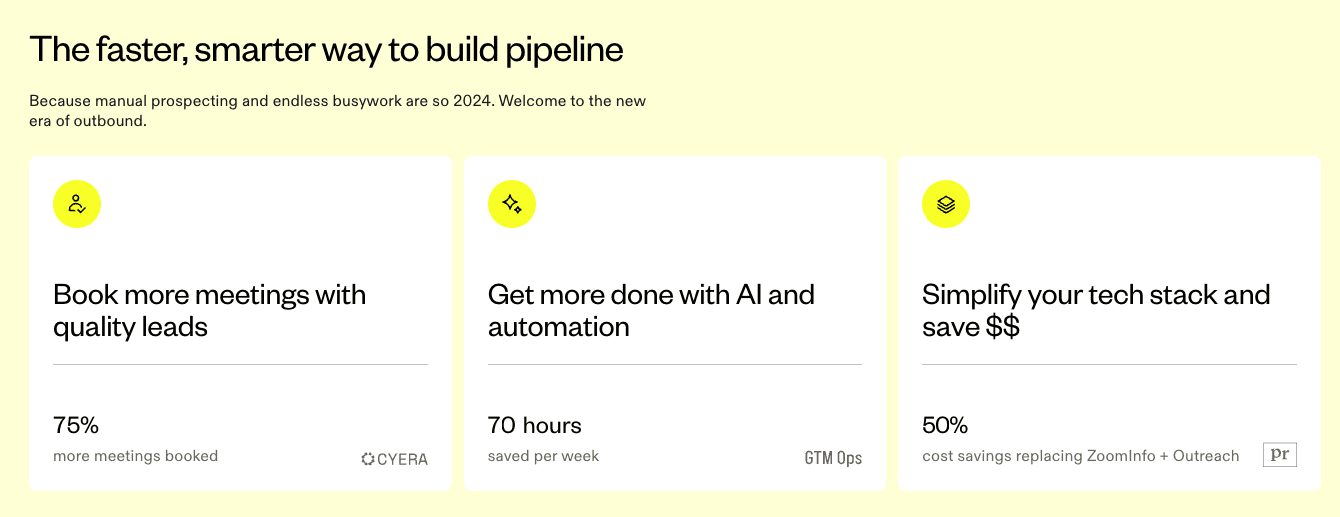
Apollo.io is a straightforward all-in-one platform that combines B2B contact and company data with outreach tools. It brings email sequences, a dialer, tasks, and light CRM features into one simple interface. Early-stage sales development reps get value from fast list building and quick outbound without bouncing between apps. Pre-seed and seed founders avoid the hassle of stitching together many tools just to start selling. Sales-led startups doing ideal customer profile discovery benefit from data and engagement in one place.
Apollo.io doesn’t fit every team. Large enterprises with strict data residency rules or needs for highly customized go-to-market operations may run into limits. Teams with complex CRM workflows or companies that must stick only to vendor-approved datasets may find the platform too restrictive.
Most users start by identifying ICP accounts in Apollo’s database, then filtering contacts, verifying emails, and pushing prospects into automated sequences. They track opens, replies, and meetings, and the system logs activity back into their CRM. Calls and SMS happen in the same tool.
This review takes a hands-on look at how well Apollo performs across key areas. It checks data coverage accuracy versus bounce rates, how often enrichment matches real-world info, the basics of sequence deliverability, dialer quality, depth of multi-channel outreach options, reliability of integrations, and what each plan tier delivers for the price.
On this page
- Data quality and enrichment for startups, with clear email accuracy expectations
- How to run outbound in one place with Apollo’s sequences, dialer, and multi-channel tools
- Making Apollo work with your CRM and stack through reliable integrations
- Apollo.io pricing for early-stage teams and a simple 14‑day proof‑of‑concept plan
Data quality and enrichment for startups, with clear email accuracy expectations
Testing Apollo.io’s data coverage starts with a clear ICP. Let’s say the target is US SaaS companies with 11 – 200 employees and VP+ GTM roles. Compare total records here with LinkedIn or another tool, then look at how many include direct emails. Direct emails drive first-touch outreach, so weigh both volume and reachability.
Apollo tags each email with confidence levels and verification statuses. A smart trial move is to pull a 200-contact sample and run an A/B test across sequences. Track bounce rates. A warmed domain should keep hard bounces under 3%. Anything above 5% signals an issue with list quality or verification.
Startups often turn to Apollo to enrich CRM data. Add firmographics like employee size, industry, and location to give reps a clearer picture. Layer in technographics, such as whether a company uses Salesforce, HubSpot, or AWS, to tailor messaging. Expect roughly 60 – 85% match rates for US SaaS SMBs to mid-market, with lower rates for very small companies or international lists.
Fresh data matters. Apollo shows last confirmation dates and flags job changes through frequent recrawls. Filter by “recently verified” before launching campaigns to cut bounce risk. Stale emails fall out early when this filter is in place.
On GDPR and CCPA, Apollo includes opt-out tools and profile-level consent details. Teams still need strong discipline. Document lawful bases for outreach, maintain suppression lists, and honor do-not-contact flags that sync from CRMs and other systems.
How to run outbound in one place with Apollo’s sequences, dialer, and multi-channel tools
Apollo’s sequence builder feels flexible for an all-in-one tool. It supports email steps, call tasks, LinkedIn reminders, and manual follow-ups. Send windows keep messages out of odd hours, and scheduling by the prospect’s time zone avoids 6 a.m. pings. Throttling keeps outreach natural, and conditional logic pauses or shifts steps if a reply comes in early. Reps don’t have to babysit every step, yet responses still get timely attention.
Deliverability gets real focus. Custom tracking domains keep links branded and more trustworthy. For new mailboxes, third-party warmup integrations guide daily sends. A safe starting point is about 30 to 50 emails per day in week one to protect domain reputation from sudden spikes that trigger spam filters.
The dialer stands out during a trial. Click-to-call runs in the browser without extra software, which speeds up high-volume sessions. Local presence numbers cover many countries and area codes so calls look familiar on caller ID. Call recording supports coaching and compliance. Disposition logging keeps notes tidy after each conversation. Voicemail drop saves time with pre-recorded messages. Pricing is usually per seat, not usage-based, so teams should confirm details before rollout.
LinkedIn outreach relies on semi-automated task reminders rather than auto-messaging bots. It nudges reps to engage personally and avoids blasting connections with robotic pitches. SMS features vary by region and number setup. In the U.S., compliant A2P 10DLC registration is required for legal, reliable texting.
Campaign performance shows up in dashboards with open rates, replies, meetings booked by sequence step, and call connect rates. Time-to-first-response metrics show how fast prospects react after first touch.
A practical way to compare multi-channel effectiveness: run two sequences to 100 contacts each and change only the first-line angle. If one drives over 20% more replies, the message is closer to what the audience wants.
Typical multi-channel outreach might roll out like this:
- Send initial personalized email timed for the recipient’s workday start
- Follow-up call task scheduled two days later with a local presence number
- LinkedIn connection request or engagement reminder shortly after the call attempt
- Second email nudge that uses any prior interaction insight
- Manual task for a customized follow-up or voicemail drop based on response status
Making Apollo work with your CRM and stack through reliable integrations
Apollo.io’s native CRM integrations with HubSpot and Salesforce aim to keep data in sync without drama. Test field mapping across both systems, with special attention on custom and standard fields. Run a round‑trip sync to confirm updates in Apollo push back to the CRM and pull in correctly. Check lead, contact, and account object behavior, plus ownership rules. A short, focused test now prevents messy fixes later.
Calendar sync tends to trip teams up, but it’s solid here. Google and Microsoft calendar links attach meetings and booked calls to the right contacts and sequences in Apollo. No more manual logging or guessing where a call went. Reports line up, and time isn’t lost chasing records.
Apollo connects with more than CRMs and calendars. Slack alerts notify reps about hot replies so they can respond fast. Zapier or Make webhooks trigger actions, like sending product signups to enrichment or pushing inbound form fills through APIs. These touchpoints tie outreach into the rest of the stack without heavy code.
Clean data matters as much as synced data. Define field maps upfront to avoid overwriting sensitive info. Lock down write access on specific CRM fields to block unwanted changes from Apollo. Sync suppression lists so opted‑out contacts stay out of enrichment and sequences. That protects compliance and honors prospect choices.
Team controls keep operations steady as founders, SDR contractors, and growing teams work together. Seat roles set access levels. Permissions control who sees lists and sequences. Shared and private mailboxes keep messages tidy. Audit logs record activity for accountability. Leaders get visibility, and outbound stays coordinated instead of chaotic.
Apollo.io pricing for early-stage teams and a simple 14‑day proof‑of‑concept plan
Early-stage teams considering Apollo.io should take a careful test drive before buying. Pricing has quirks – monthly email credits, dialer add-ons, daily send caps – that can throw off budgets. A short proof-of-concept that checks data quality, deliverability, and integration fit avoids long commitments.
Start small. The Free plan offers basic search and limited credits but hits limits fast for active outreach. Starter or Basic raises monthly email limits and sequence steps enough for lean sales squads with 1 – 2 SDRs. Professional adds automation and reporting for more complex workflows. Organization brings SSO and priority support for larger setups.
Hidden limits cause trouble. Daily sending caps per mailbox throttle campaigns. Exporting contacts may have monthly ceilings. Multi-mailbox linking often needs higher tiers or extra fees. Dialer minutes usually aren’t included, so factor in those costs if calling matters.
Take a tiny team with two SDRs and a founder across three mailboxes. Expect roughly 3 – 5k verified emails a month and light calling. Add dialer minute packages and any extra seats with care to avoid billing surprises.
A straightforward path forward:
- Define the ideal customer profile with firmographic filters.
- Pull about 300 contacts from Apollo’s database that match the ICP.
- Split them into three sequences to test different messaging angles.
- Track bounce rates and aim below 3% to confirm list health.
- Compare reply rates to the current tool to gauge improvement.
- Sync at least ten records back into the CRM to verify smooth data flow.
- Make around twenty calls through Apollo’s dialer to assess call quality and ease of use.
- Review total cost versus outcomes before choosing a plan.
This hands-on trial keeps risk low and shows whether Apollo.io’s pricing and plans align with an early-stage company’s goals. It also answers a practical question: is Apollo.io worth it for early-stage teams? These steps help ensure the purchase isn’t just software, but an investment that moves results.
Leave a Reply